

In this guide (7 sections)
The agency fee is only one part of the hiring cost. Maid agency administrative service fees may cover placement coordination and paperwork, while document submissions, training, accommodation and other expenses may be included or charged separately. The quotation should show what each amount covers.
It is reasonable to want a clear explanation before hiring a domestic helper in Singapore. A quoted amount may combine agency services with government charges or other costs. Reviewing each line helps you understand what you are paying for and what may be billed separately.
This article explains the administrative work an agency may handle, how document submissions and placement services fit into the fee, and which other charges to look for. You’ll learn how to distinguish agency service fees from separate hiring expenses and assess a quotation more clearly.
Key Takeaways
- New-helper and transfer-helper placements can involve different agency service fees, so identify which hiring route the quotation covers.
- Administrative charges may cover coordination and document preparation; look for a clear breakdown of what is included.
- Training, accommodation and other placement-related expenses may be separate from the agency’s service fee.
- Separate agency charges from government and third-party costs to understand the full hiring expense and how each item is handled.
What Are Maid Agency Fees?
Agency fees cover services related to hiring and placing a domestic helper, but quotations may include different tasks. Compare the stated scope of service, not just the total.
Hiring Support and Fee Transparency
An agency coordinates placement and related administration for families. A clear breakdown shows which tasks the fee covers and which expenses are separate.
For example, a quotation might list candidate matching, paperwork coordination and application handling as separate services. These descriptions help distinguish agency work from government or third-party charges. Check that it identifies the placement route, the support provided and any separate costs. This makes the total easier to understand before the application proceeds.
Comparing Agency Service Fees
To compare agency fees fairly, review quotations for the same hiring route and scope of work. A new helper placement and a transfer involve different circumstances.
Compare what each quotation includes, such as candidate matching, profile coordination and paperwork support. Fresh helpers are recruited from overseas; ex-Singapore helpers have worked in Singapore before; transfer helpers are already in Singapore and changing employers. These categories describe different hiring routes, so compare equivalent services rather than relying on labels alone.
Contract terms, renewals and transfers are separate considerations from the initial placement fee. The written employment agreement sets out the contract period and relevant terms; a renewal or transfer may require different administrative work from a new placement. When reviewing quotations, identify the helper category and hiring route, then check which services the fee covers. This helps you compare the scope and understand each charge.
Administrative work and document submission
Agency administrative fees may cover preparing employer and helper details, assembling supporting documents and coordinating a Work Permit application. Application and issuance charges are separate government costs, so a quotation should distinguish them from agency fees. Check whether application preparation and submission coordination are included or charged separately.
Other hiring expenses may include medical screening and insurance. Their amounts depend on the relevant service or policy, so list them separately rather than treating them as one agency charge. According to the Ministry of Manpower, employers must arrange a S$5,000 security bond for non-Malaysian helpers. This bond is distinct from documentation work and agency administration.
Work Permit applications require employer and helper details, along with supporting documents. Administrative handling may include preparing paperwork, submitting the application and coordinating follow-up. A separate processing charge may also apply. A fee breakdown should name the tasks covered instead of grouping agency work and government charges under an unclear label.
Application processing depends on the application and supporting information. Missing or inconsistent details may require follow-up, while complete paperwork can help avoid that extra step. Candidate matching is separate from permit administration, even when both services appear in one quotation.
Before comparing totals, check whether the quotation covers application preparation, submission coordination and follow-up. Look for separate charges for replacement arrangements. Then distinguish upfront agency fees from Work Permit, medical screening, insurance and bond-related costs. Salary is an employment cost, not a document-submission fee. Reviewing each item clarifies what every payment covers.
Additional charges for documentation, biodata, training and accommodation
Documentation and biodata charges may cover preparing a helper’s information for a household to review and organising records for the hiring process. Look for separate descriptions of document preparation, biodata handling and permit-related administration. A broad “processing” line makes it harder to tell which task is being charged for and whether the same work appears elsewhere.
Training and accommodation are separate cost categories. A training charge should identify the programme or provider, while an accommodation charge should explain the period or arrangement it covers. For example, a quotation may list training separately from temporary accommodation during recruitment. Combining both as one unexplained expense obscures who provides each service and what the charge pays for.
Loan handling also needs clear wording. A helper’s placement loan is not the same as an employer’s agency service fee. If the quotation includes loan administration or a fund-transfer charge, identify the service, who pays it and how it relates to any repayment arrangement. This helps prevent a loan amount from being mistaken for a documentation or placement charge.
Are fees refundable if a Work Permit is rejected or a placement falls through? Refund eligibility depends on applicable rules and the agreement for the specific transaction. When reviewing the terms, distinguish agency service fees from government charges, third-party training expenses and other costs. Match each line to a named service, provider or document; note whether it is included or billed separately, and review any refund conditions before proceeding. This makes unclear charges easier to identify without assuming the same refund terms apply to every expense.
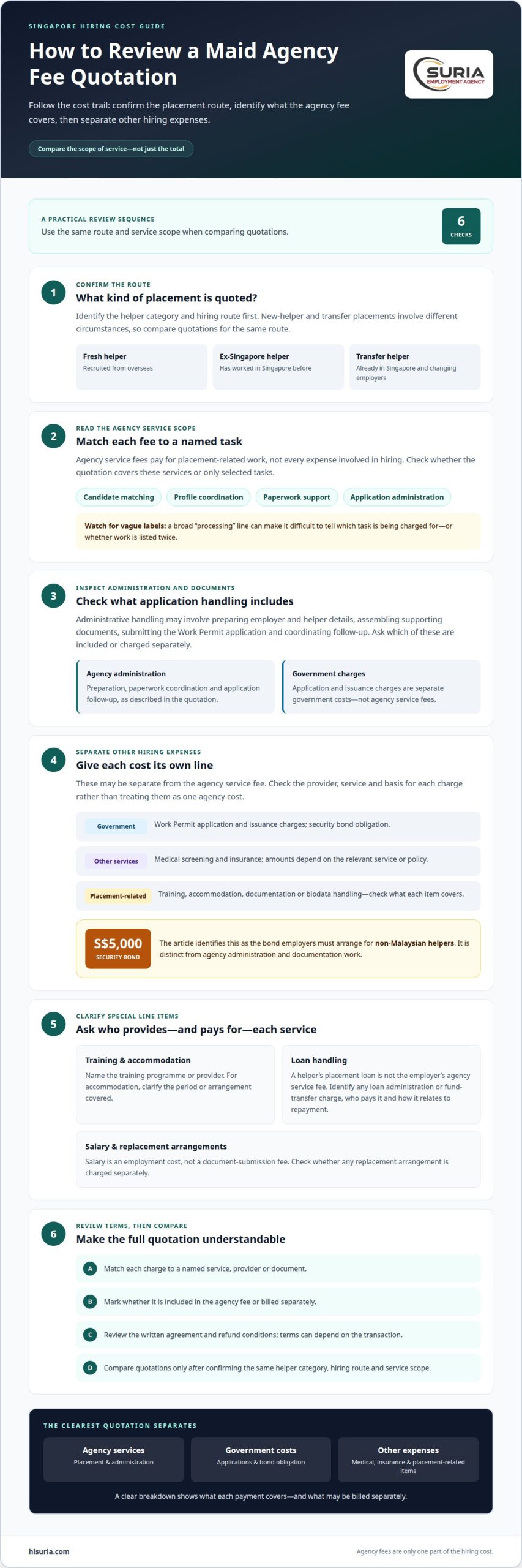
Domestic-helper agency service fees
A service fee pays for agency work related to placement, not every expense involved in hiring a domestic helper. In Singapore, compare the scope of service: does the quotation cover candidate matching, profile coordination and application administration, or only selected tasks? You can compare offers more fairly by matching each listed service to the hiring route and placement support described.
Separate agency charges from government and third-party costs. For example, the Ministry of Manpower’s security bond is an employer obligation, not payment for candidate profiles or agency matching. Work Permit charges, medical checks, insurance, travel or training expenses may also fall outside the agency fee. An itemised quotation should identify each category and show whether it is included, billed separately or paid to another party.
Read the employment agency agreement alongside the quotation. Check which services the fee covers, when payment is due and how the agreement handles a placement that does not proceed. If a line says “administration,” identify the work it describes. A clearly named task, such as preparing application documents, is easier to assess than a broad label without an explanation.
Also distinguish an employer’s service fee from a worker’s placement fee or placement loan. These are different charges and should not be merged into one unexplained total. Record any loan repayment arrangement separately from the household’s invoice. The practical takeaway is simple: compare the same placement scope, separate agency work from other costs, and use the written breakdown to understand each payment.
How Suria Employment Agency Can Assist
Suria Employment Agency supports Singapore households with domestic-helper placement and related services. The right starting point depends on whether you have identified a helper, need a new placement or are arranging a helper’s departure. Understanding the service scope helps you connect each quotation charge to the work involved.
Suria provides Direct Hire Services for employers who have already identified a domestic helper. This differs from a placement where the agency helps match a household with a suitable candidate. The quotation should make clear which support relates to direct hiring and which costs are separate government or third-party charges.
Suria’s Job Placement Services for New & Transfer Maids cover households seeking a new helper or considering a transfer helper who is already in Singapore and changing employers. These routes involve different circumstances, so the related administrative work and quoted scope may differ. Identifying the route first makes the fee breakdown easier to understand.
Suria’s Repatriation Service helps arrange a helper’s return from Singapore. It is separate from recruiting or placing a domestic worker and is relevant when employment is ending and repatriation support is needed. Keeping this service distinct from placement charges helps clarify what each part of a quotation covers.
For a useful comparison, identify the service you need, then review which tasks the quotation covers and which expenses are billed separately. This helps you understand the charges for placement, direct hire or repatriation without treating every cost as the same type of fee.
To discuss your household’s requirements, contact Suria Employment Agency.
Frequently Asked Questions
Are there any extra or hidden costs?
Some hiring expenses may be outside the agency’s quoted service fee. For example, an employer may pay separate costs for the helper’s salary, monthly levy, insurance, medical checks or travel arrangements. These are not automatically hidden charges; they should be identified by their purpose and payer. Compare the written quotation with the employment agreement to see how each item is handled.
What should you expect to pay?
Singapore does not have one standard agency price that applies to every placement. The amount depends on the hiring route and the work included, such as matching, documentation, or application handling. To assess a quotation, compare the same type of placement and service scope, then separate one-time agency charges from recurring household costs. A headline price alone cannot show whether two offers cover the same work.
Who pays the placement fee?
The employer pays the agency charges set out in the agreement with the agency. A helper may also have a separate worker-paid placement charge, which is not the same as the employer’s service fee. Keep these as distinct items in any cost summary. Check who is responsible for each payment and how any worker-paid amount is handled, rather than assuming one party covers every charge.
Why do these fees exist?
Agency fees pay for work involved in arranging a placement and supporting the hiring process. This may include assessing household requirements, presenting suitable candidates, coordinating interviews and handling relevant paperwork. The work differs between a direct hire and a placement that requires candidate matching. A clear service description explains the charge and helps employers decide whether the support suits their needs.
What administrative service fees do employment agencies in Singapore charge?
There is no single fixed administrative fee across Singapore agencies. Charges depend on which tasks the agency handles and whether they are bundled with placement support or listed separately. A useful quotation identifies the work covered, such as document preparation or application coordination, and distinguishes it from government or third-party expenses. Compare itemised descriptions, not just labels such as “administration” or “processing”.
What is the typical total cost of hiring a domestic helper through an agency in Singapore?
The total depends on the placement route, agency services and separate employment expenses, so one figure will not represent every household. Build a budget by separating agency charges from recurring salary and levy costs, as well as insurance and other applicable expenses. Note which costs arise before placement and which continue during employment. This gives you a clearer picture than comparing agency fees alone.
Disclaimer
The articles published on this website are provided for general informational purposes only. While we strive to keep the information accurate and up to date, we make no warranties regarding its completeness, reliability, or accuracy. Readers should verify information independently and seek qualified professional advice when appropriate. Any reliance on this content is at the reader's own risk.
Need help hiring a helper?
Our consultants will shortlist suitable helpers and handle the MOM paperwork for you.