In this guide (7 sections)
An agency fee is only one part of the cost of hiring a new domestic helper in Singapore. To understand the fees for hiring a new domestic helper, look beyond the headline figure at what the package includes and how the helper is recruited. The package scope determines which services are covered and which costs are paid separately. Reviewing these details helps you understand the financial commitment before choosing a placement option.
Understand the terms before deciding to hire. This guide explains how to read an agency fee breakdown, distinguish placement charges from other costs and assess the clarity of an agreement. It also covers budgeting for a migrant domestic worker, from initial arrangements to recurring household expenses. Compare package details on a like-for-like basis and focus on what matters for your family’s needs, expectations and desired level of support.
Key Takeaways
- Separate agency charges from other one-off and ongoing hiring expenses, and account for how a new placement differs from a transfer.
- Ask for a clear breakdown of placement, programme and loan-related costs so you can understand what is payable upfront and what may be deducted over time.
- According to the Ministry of Manpower Singapore, the S$5,000 security bond applies to each helper except Malaysian helpers; include it in your budget planning.
- According to the Ministry of Manpower Singapore, the normal monthly levy is S$300 for the first helper and S$450 for subsequent helpers, while eligible households may pay the S$60 monthly concessionary rate.
Employment agency fees and other MDW hiring costs
A recruitment package may cover candidate matching, placement coordination and paperwork, as detailed in its fee breakdown. The agency handles sourcing and Work Permit administration. Employers provide household requirements and application information, then review profiles and choose a helper.
Agency and Transfer Hiring Costs
Agency placement, transfer placement and direct hire differ in how recruitment and administrative tasks are handled. Agency placement may include recruitment coordination. With a transfer, the helper is already in Singapore; with a direct hire, the employer has identified a helper and needs help with the hiring process. Each route involves different services and possible third-party expenses, so compare the written breakdown instead of assuming one option costs less.
Recruitment Packages and Hiring Steps
A recruitment package sets out the agency’s role, from sourcing candidates to placement and related paperwork. The process generally involves sharing household needs, reviewing suitable profiles, choosing a candidate and completing the required employment documents. Employers provide accurate application details and explain their needs; the agency coordinates the recruitment and paperwork included in the package.
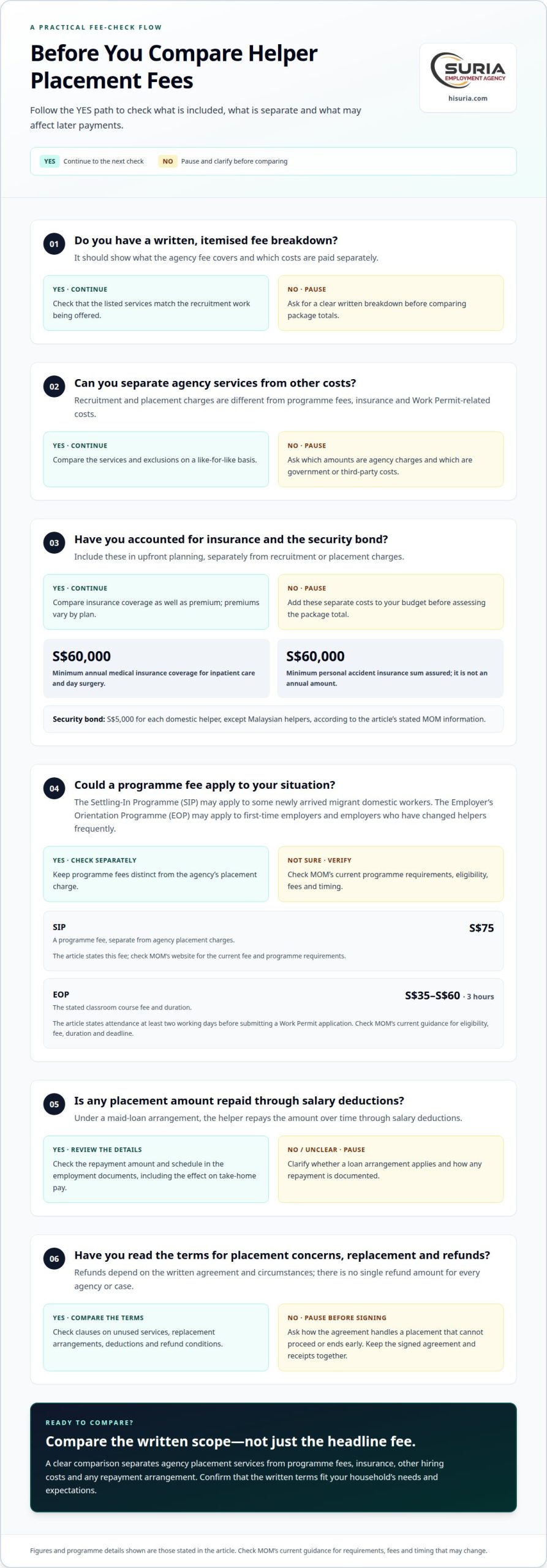
Insurance is another hiring cost. A domestic helper must have medical insurance with at least S$60,000 in annual coverage for inpatient care and day surgery. Personal accident insurance must provide a sum assured of at least S$60,000; this is not an annual amount. Premiums vary by plan, so compare coverage as well as price.
Work Permit application and issuance fees are separate from agency charges. The Ministry of Manpower Singapore requires employers to pay a S$5,000 security bond for each domestic helper, except Malaysian helpers. Include that bond in the household’s upfront financial planning, alongside insurance and any recruitment or placement costs.
Domestic helper agency fees
To understand recruitment charges, separate placement services from programme fees and payment arrangements. A written breakdown should show what the agency fee covers and which costs are payable separately. This helps you compare the fee with the recruitment work provided, without confusing placement charges with required courses or later salary deductions.
The Settling-In Programme (SIP) may apply to some newly arrived migrant domestic workers. The stated fee is S$75; check the Ministry of Manpower (MOM) website for the current fee and programme requirements. Keep this separate from the agency’s placement fee: the SIP relates to the programme, while placement charges cover recruitment arrangements.
Placement fees cover the agency’s recruitment and placement work. The amount depends on the package and services involved, so read the itemised terms rather than treating the total as a government fee. Employers typically pay this fee upfront. Under a maid-loan arrangement, the helper repays the amount over time through salary deductions. Review the repayment amount and schedule in the employment documents so both parties understand how deductions affect take-home pay and daily expenses.
The Employer’s Orientation Programme (EOP) may apply to first-time employers and employers who have changed helpers frequently. The stated classroom course fee is S$35 to S$60, and the course lasts three hours. The stated attendance timing is at least two working days before submitting a Work Permit application. Check MOM’s current guidance for eligibility, course fees, duration and attendance deadlines, as these details may change. Treat the EOP charge as a course fee, not an agency placement charge.
When reviewing recruitment charges, separate placement services from SIP, EOP and any loan repayment arrangement. This clarifies which costs are due upfront, relate to a programme or affect the helper’s later salary.
Agency fee transparency and reputation
Compare Singapore agencies by the services included, not just the package total. A written breakdown of agency fees for a new helper placement should identify candidate sourcing, document coordination and Work Permit assistance. Compare each package’s inclusions and exclusions. A household seeking elderly-care support may need a helper with different experience from one focused on general household tasks, so check that the stated service scope matches your needs.
Review itemised charges, service scope and written terms. Check whether the agency fee is separate from government or third-party costs. Confirm which employment documents the agency prepares and what information you must provide. Look for clear explanations, consistent terms and a defined process for placement concerns. Salary figures alone do not show value, as experience and agreed employment terms also affect pay.
If employment ends early or a placement does not work out, any refund depends on the written agreement and the circumstances. There is no single refund amount that applies to every agency or case. Before signing, read the clauses on unused services, replacement arrangements, deductions and refund conditions. This helps distinguish agency charges from amounts already paid to another party.
For example, ask how the agreement handles a Work Permit application if placement cannot proceed, and whether unused service charges are refundable. Check what the terms say if a helper leaves during an agreed period and what records you may need. Keep the signed agreement and receipts together. Comparing these details with the agency’s fees for a new helper placement clarifies the responsibilities and possible remedies for both the household and the agency.
Financial readiness to hire an MDW
Financial readiness means being able to meet employment costs over time, not just paying for placement. Before committing, consider how the helper’s salary and household expenses fit with your existing monthly obligations. Account for ongoing responsibilities after the helper starts work, including providing meals and meeting medical needs. This gives you a clearer picture of whether the arrangement fits your budget in the long term.
The Ministry of Manpower Singapore states that the normal monthly migrant domestic worker levy is S$300 for the first helper and S$450 for subsequent helpers. Singapore households that qualify for the domestic worker levy concession pay S$60 per month, according to the Ministry of Manpower Singapore. Identify which rate applies to your household and include it as a recurring expense, rather than treating the levy as part of the one-time hiring budget.
Review cash flow across a typical month. Salary and levy recur, while placement and other hiring costs fall at different stages. Keeping these categories separate shows which expenses need to be paid upfront and which must remain affordable after employment begins. Planning only for the first payment can leave you unprepared for the ongoing costs of employing a foreign domestic worker.
Include insurance and medical needs in your budget. Consider the required personal accident insurance and medical insurance, which covers inpatient care and day surgery subject to the policy terms. Medical expenses vary with the helper’s needs, so leave room in your household budget for care rather than planning around routine costs alone. Employers are also responsible for providing appropriate accommodation and supporting the helper’s daily living. Reviewing these costs together helps you judge whether your household can support the arrangement responsibly.
Suria Employment Agency: Experience Indonesian Domestic Helpers
Suria Employment Agency helps Singapore households seeking an Indonesian domestic helper. Through its Experience Indonesian Domestic Helpers offering, it supports families looking for a placement suited to their routines and care needs. Explain who needs assistance, the daily tasks involved and the experience you value to give the placement discussion a practical focus from the start.
For a new hire, New Maid Placement provides recruitment support and helps households arrange placement. Tell the agency your priorities, such as childcare, household tasks or support for an elderly family member. Clear expectations about duties and routines help identify the experience that may suit your family. The final choice is yours.
Some needs arise after a helper starts work. Home Leave Processing supports arrangements for a helper’s home leave, while Renewal & Endorsement of Passports covers passport renewal and endorsement. These are ongoing administrative services, separate from initial placement. Consider them separately to distinguish hiring decisions from later document and leave arrangements.
Before choosing a placement route, consider your household’s needs, the helper’s responsibilities and the experience that would be useful. A family prioritising childcare, for example, may have different expectations from one seeking help with cooking and general chores. Explain these differences to make the placement discussion specific and give yourself a clearer basis for deciding whether the arrangement suits your household.
For a discussion about Indonesian domestic helper placement, contact Suria Employment Agency.
Frequently Asked Questions
What are the current domestic helper agency fees in Singapore?
There is no single fee that applies to every agency package. Suria Employment Agency’s packages start from S$1,843.10, including the agency fee, service fee and insurance. Compare the stated inclusions rather than treating that starting price as a market-wide rate. A package that covers different services may have a different price, so review the written breakdown before deciding.
What are the typical maid agency fees for hiring a new helper versus a transfer helper?
New and transfer placements involve different recruitment arrangements, so fees depend on the services included and how the helper is engaged. A new placement may involve overseas recruitment coordination; a transfer involves a helper already in Singapore. Compare the written package for each route, including administrative work and replacement terms, rather than assuming a transfer always costs less.
What additional costs apply, such as work permit, medical exam, insurance, and security bond?
Budget separately for government charges and ongoing household expenses. Work Permit application and issuance fees total S$70. Two medical examinations are estimated at S$60 to S$80 a year. Insurance must cover at least S$60,000 a year for inpatient care and day surgery, with at least S$60,000 per year for specified personal accident events. According to the Ministry of Manpower Singapore, the S$5,000 security bond applies except for Malaysian helpers.
What are the MOM rules and fee caps for domestic helper agency fees in Singapore?
Keep agency charges separate from amounts payable to the Ministry of Manpower Singapore. The S$5,000 security bond is a government requirement for each helper, except Malaysian helpers; it is not an agency placement fee. For any fee-cap question, clarify whether the charge is payable by the employer or the helper, and identify the relevant rule and payer in the written agreement before signing.
What should employers check before signing a maid agency contract in Singapore?
Check that the contract lists each charge, its purpose, when it is due and any third-party costs. Read the placement scope, cancellation terms, replacement conditions and refund provisions carefully. Confirm how salary deductions for any helper loan are documented, and keep copies of the signed agreement and receipts. If a charge is described only as “administration,” ask what specific task it covers and who receives the payment.
What common hidden charges or risks should employers look out for when hiring a domestic helper?
Check for costs not included in the initial quote, such as separate documentation, insurance or programme charges. Ask whether each item is included in the stated total and whether any payment is refundable if placement does not proceed. Review maid-loan deductions and replacement conditions too. A low headline fee is hard to compare when exclusions, payment dates or the consequences of early employment termination are unclear.
Disclaimer
The articles published on this website are provided for general informational purposes only. While we strive to keep the information accurate and up to date, we make no warranties regarding its completeness, reliability, or accuracy. Readers should verify information independently and seek qualified professional advice when appropriate. Any reliance on this content is at the reader's own risk.
Need help hiring a helper?
Our consultants will shortlist suitable helpers and handle the MOM paperwork for you.