

Singapore’s mandatory rest day rules require employers to give migrant domestic workers (MDWs) one rest day each week. At least one rest day in each calendar month must be taken as a day off and cannot be replaced with payment. This minimum matters when planning household routines and discussing whether other rest days may be worked for compensation.
The employer and helper should agree on a practical schedule and make the arrangement clear in writing. This guide explains the weekly and monthly minimums, when work on another rest day may be compensated, and what to record. It also explains how to approach scheduling and where to check the latest Ministry of Manpower (MOM) instructions, including relevant FDW eService requirements.
Key Takeaways
- An MDW must receive one rest day each week, and at least one rest day per calendar month must be taken without work. Payment cannot replace this monthly rest day.
- Discuss the schedule with your helper and agree on arrangements together. Check current MOM guidance before arranging split or deferred rest days.
- Record the agreed schedule and any agreement to work on another rest day, including the compensation arrangement where applicable.
- When reviewing the schedule, confirm that it meets MOM’s requirements, discuss any changes, update relevant records, and check the latest instructions.
Mandatory rest day rules for domestic helpers in Singapore
Singapore’s mandatory rest day rules for migrant domestic workers (MDWs) require employers to provide one rest day each week. At least one rest day in each calendar month must be taken as an actual day off, not replaced with payment. The employer and helper agree on when the weekly rest day falls, so it does not automatically have to be on Sunday. See MOM’s guidance on MDW rest-day entitlement for the current requirements.
In short: provide one rest day each week, and ensure at least one rest day per calendar month is taken without work.
How often must an employer provide a rest day?
Plan for a rest day each week and make sure at least one rest day in each calendar month is taken without work. You and your helper should agree on a day that works for both of you. For example, you may agree on a weekday rather than Sunday, provided the arrangement meets MOM’s requirements.
The monthly minimum is not an additional rest day on top of the weekly entitlement. It means that at least one of the rest days in that calendar month cannot be exchanged for compensation. MOM’s guidance sets out the arrangements that may apply to other rest days.
Which rest-day guidance applies to migrant domestic workers?
MDWs are not covered by the Employment Act’s general provisions, including Part 4 rest-day rules for employees within that part’s coverage. Employers should follow the MDW-specific requirements set by MOM rather than applying general employee calculations to a domestic helper. The Employment of Foreign Manpower Act provides the relevant legislative framework, while MOM’s MDW rest-day guidance explains the requirements for helpers and their Work Permits.
For a current arrangement, refer to MOM’s MDW rest-day instructions and relevant Work Permit conditions. This helps you plan a workable household schedule without confusing an MDW’s entitlement with rules that apply to other groups of employees.
Can a domestic helper’s rest day be compensated or deferred?
An MDW may agree to work on a rest day other than the protected monthly rest day. For each rest day worked, the employer must pay at least one day’s salary in addition to the monthly salary. MOM calculates this as the helper’s total monthly salary divided by 26. This is specific MDW guidance, not a Part 4 overtime formula.
What happens if a helper works on an agreed rest day?
The agreement must be mutual. Payment for working on an eligible rest day does not remove the requirement to provide at least one actual, non-compensable rest day each month. Keep a clear record of the agreement and payment. The Straits Times has reported on the enforcement of the mandatory rest day, highlighting that compensation for other rest days cannot replace the protected day.
Can rest days be split or deferred?
MOM allows a rest day to be taken as one full 24-hour period or, by mutual agreement, as two half-days. If an MDW is unable to take a rest day within a month, it may be deferred by agreement, but must be taken by the end of the following month. These options affect when the rest day is taken, not the minimum entitlement.
| Arrangement | What it means |
|---|---|
| Rest day taken | The helper has a full day off or, by agreement, two half-days. |
| Agreed work | For a non-protected rest day, the helper may agree to work and must receive at least one day’s salary, calculated as total monthly salary divided by 26, in addition to monthly pay. |
| Deferment | If the helper is unable to take a rest day within the month, it may be deferred by agreement and taken by the end of the following month. |
Rest-day expectations are worth discussing while planning a placement. If you are considering a new or transfer helper, learn about helper placement support as you plan household arrangements.
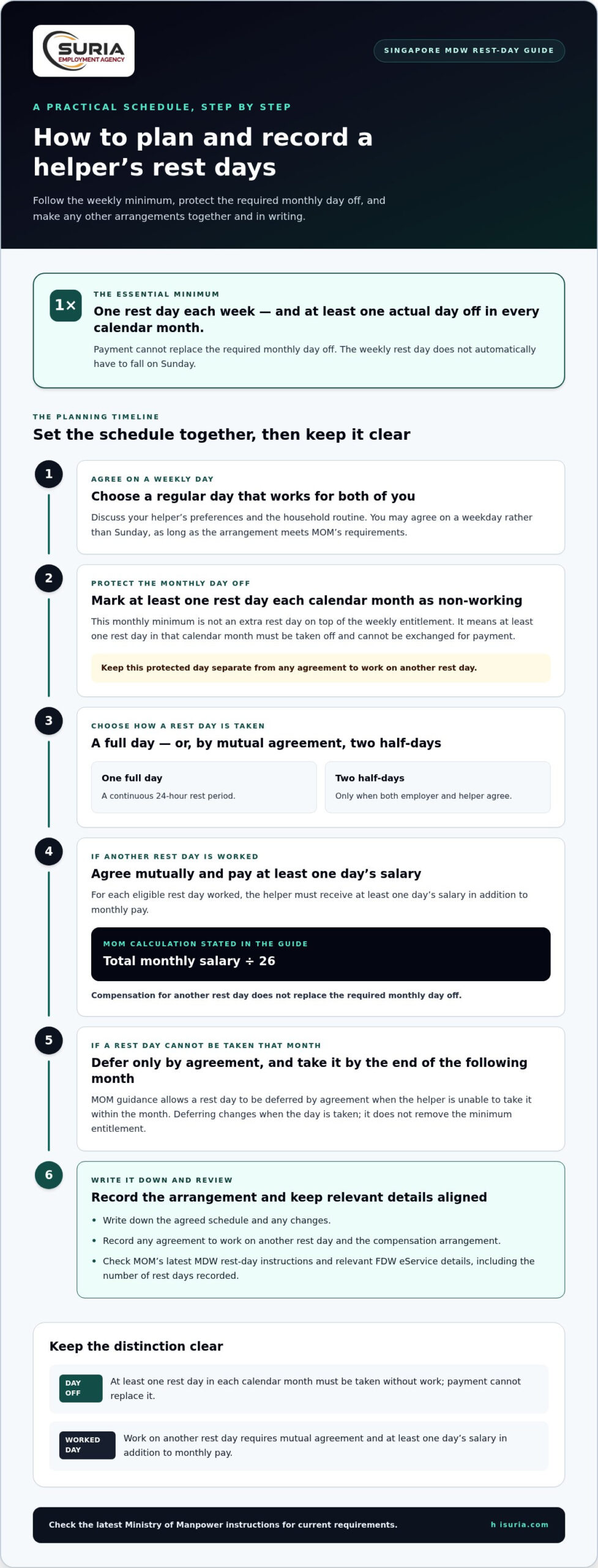
How to agree, schedule, and record rest days
Start with a respectful discussion about your helper’s preferences and the household routine. Agree on a regular day where possible, then decide how to handle changes while keeping the minimum requirements in view. Employers preparing for a placement can also refer to the first-time employer guide to new maid placement when setting expectations around time off.
What to discuss before setting a schedule
Discuss the proposed day, household routines, and each person’s scheduling preferences. MOM allows a rest day to be taken as one full day or, by mutual agreement, as two half-days. Write down the arrangement and any changes. Agreement on scheduling does not remove the minimum entitlement or mean that the helper must give up the protected rest day.
Where employers should check current instructions
Check MOM’s current MDW rest-day guidance if you are unsure how an arrangement applies. MOM also provides the FDW eService for relevant transactions, including updating the number of rest days. Keep your written schedule and any changes aligned with the information recorded there. If circumstances change or the proposed arrangement is unclear, review MOM’s latest instructions before making an adjustment.
Direct-hire processing involves different steps from an agency placement. Employers using that route should account for the relevant administrative requirements when planning employment arrangements.
If you are planning a new or transfer placement, explore Suria’s helper placement support as you prepare for the arrangement.
A practical next step for employers reviewing rest-day arrangements
Review your household routine against the mandatory rest day rules. Compensation for working on an eligible rest day does not remove the obligation to provide the required actual rest day each month. A clear written record and regular review can help prevent misunderstandings when the schedule changes.
A short review checklist for employers
- Verify the minimum: Check MOM’s current guidance on weekly and monthly rest-day requirements.
- Confirm the agreement: Make sure you and your helper understand the schedule, including any mutually agreed compensation arrangement for a rest day worked.
- Keep the record current: Write down the agreed schedule and any changes, and complete any applicable FDW eService update.
- Review when things change: If household routines or the arrangement shift, discuss a new plan respectfully and follow MOM’s latest instructions.
When placement support may be useful
Rest-day expectations are one of several employment arrangements to discuss during helper placement. Raising them early helps both parties understand the proposed schedule before work begins, while keeping the required minimums clear.
Suria Employment Agency has operated since 2002 and holds MOM Employment Agency Licence No. 02C2836. The agency supports employers considering a new or transfer helper placement. MOM remains the authority for current regulatory instructions. If you are planning a placement, you can contact Suria about helper placement support.
Keep the arrangement clear and current
Build the schedule around MOM’s minimum requirements, agree on workable timing with your helper, and keep a written record of the arrangement. The mandatory rest day rules distinguish the monthly rest day that must be taken from other rest days that may be worked by mutual agreement and compensated. Payment does not replace every rest-day obligation.
Review the arrangement when household routines change, and refer to MOM’s latest guidance if you are unsure how a proposed adjustment applies. Clear expectations can help both employer and helper manage time off with fewer misunderstandings.
Rest-day expectations can be discussed as part of placement planning. Suria Employment Agency provides new and transfer helper placement services. To discuss a placement, contact Suria about helper placement support.
Frequently Asked Questions
How many rest days is a domestic helper entitled to in Singapore?
A migrant domestic worker (MDW) is entitled to one rest day each week, with at least one rest day per calendar month that cannot be replaced by payment. The employer and helper should agree on the day, which does not have to be Sunday. Other arrangements must still meet the minimum entitlement. Check MOM’s current MDW rest-day guidance for details that may affect your schedule.
Can I pay my helper instead of giving her a rest day?
No. Payment cannot replace the required non-compensable rest day each month. If your helper mutually agrees to work on another rest day, you must pay at least one day’s salary in addition to her monthly salary. The mandatory rest day rules distinguish this protected day from other rest days that may be worked by agreement. Record the agreement and check MOM’s current instructions.
Can a domestic helper take a rest day in two half days?
Yes. MOM allows a rest day to be taken as two half-days if the employer and helper mutually agree. Set out the arrangement in writing so both parties understand when each half-day will be taken. Splitting a rest day does not remove the monthly non-compensable rest-day requirement. Check MOM’s guidance if you are unsure whether your proposed arrangement meets it.
Can an employer defer a domestic helper’s rest day?
Yes. An MDW’s rest day may be deferred by mutual agreement, but the deferred day must be taken by the end of the following month. Discuss the change with your helper, record the agreed dates, and make sure the arrangement does not displace the required non-compensable rest day. Deferment should not become a substitute for providing rest. Check MOM’s latest instructions if the situation is unclear.
Do Employment Act rest-day rules apply to migrant domestic workers?
No. Migrant domestic workers are not covered by the Employment Act’s general rest-day provisions, including Part 4 rules for covered employees. Employers should follow the separate MOM guidance and Work Permit conditions for MDWs rather than applying general employee calculations to a helper. If you are unsure how the rules apply to a particular arrangement, consult MOM’s current official instructions for MDWs.
Disclaimer
The articles published on this website are provided for general informational purposes only. While we strive to keep the information accurate and up to date, we make no warranties regarding its completeness, reliability, or accuracy. Readers should verify information independently and seek qualified professional advice when appropriate. Any reliance on this content is at the reader's own risk.