

A new helper doesn’t need to learn every household rule on day one. She needs a clear, respectful place to start. This maid onboarding guide is for Singapore employers who want to introduce routines without overwhelming a new domestic helper. Start with the essentials, then explain household preferences as they become relevant. A steady introduction gives both sides time to understand expectations and ask questions.
You’ll learn how to prioritise daily routines, demonstrate household tasks and agree on practical ways to communicate. You’ll also find a flexible approach to first-month check-ins, clarifying expectations and adjusting routines. The aim is to make instructions specific and manageable, while giving your helper room to get familiar with your household.
Key Takeaways
- Use this maid onboarding guide to introduce household routines gradually, starting with the tasks and expectations that matter most.
- Separate daily duties from occasional tasks, and explain what should take priority when duties overlap.
- Use regular, low-pressure check-ins to review what is clear, invite questions and adjust routines together.
- If a concern relates to placement, Suria Employment Agency can provide placement support. For formal requirements, refer to current MOM information.
Maid onboarding guide: what to cover after your helper arrives
Onboarding is the gradual introduction to your household’s routines, communication style and shared expectations. It isn’t a single briefing to complete on arrival. Your helper is getting familiar with an unfamiliar home, while your family is adjusting to a new person’s way of working. A calm, staged approach lets both sides clarify details as they arise.
Use this maid onboarding guide to decide what your helper needs to know first. Begin with introductions, meal and break routines, who to approach with questions, and the household’s immediate priorities. Save less urgent preferences for later conversations. A short list of the day’s essential routines can help you keep the first explanation focused.
Start with the essentials, not a long briefing
Introduce household members by name and explain how they prefer to be addressed. Show your helper the spaces she’ll use for her duties, where everyday items are kept, and how familiar appliances work. Explain practical safety information, such as how to reach a household member in an urgent situation and where to find basic supplies. Cover a few essentials at a time, then revisit details when they become relevant.
Make instructions clear and respectful
For an unfamiliar task, demonstrate the steps rather than relying on spoken instructions alone. For example, show how your family prefers laundry to be sorted and point out items that need special handling. Invite your helper to ask for clarification. You can also ask her to describe or demonstrate the steps back, making clear that this is a way to check whether your explanation was clear, not a test. Silence doesn’t necessarily mean she has understood or agreed. Respectful communication also means making space for her perspective. For wider context on the profession and fair treatment, see this overview of domestic worker rights.
Build household routines through clear, two-way communication
A routine is easier to follow when your helper understands both the task and its priority. Separate daily responsibilities, such as preparing meals or tidying shared spaces, from occasional tasks, such as cleaning a particular appliance. If two duties clash, explain what should come first and what can wait. For example, clarify whether preparing a meal takes priority over finishing the laundry at a particular time.
Make household preferences specific. Explain how you prefer food to be stored, which surfaces need particular care, and how family members’ schedules affect the day. Don’t rely on “the usual way” if your helper hasn’t learned what that means in your home. A useful maid onboarding guide treats these conversations as ongoing, not as a one-time list of rules.
Demonstrate routines and confirm understanding
Give short instructions and show household-specific steps where needed. Then invite clarification in a low-pressure way: “Would it help if I went through that again?” or “Which part would you like me to explain?” This makes it easier to identify a gap without turning the conversation into a test. If the task is unfamiliar or your original instruction wasn’t clear, adjust your explanation and demonstrate it again.
Make feedback a conversation
Raise concerns privately and describe the specific issue, its effect and the next step. For instance: “The wet floor near the kitchen was slippery this morning. Please dry it after mopping.” Then invite your helper’s perspective by asking what feels clear and what remains difficult. This can show whether the timing, instructions or household expectations need adjusting.
For formal requirements, including rest-day rules, refer to the latest Ministry of Manpower (MOM) guidance. If a recurring concern relates to placement, Suria Employment Agency can help with placement-related questions.
Follow a flexible first-month plan for check-ins and adjustments
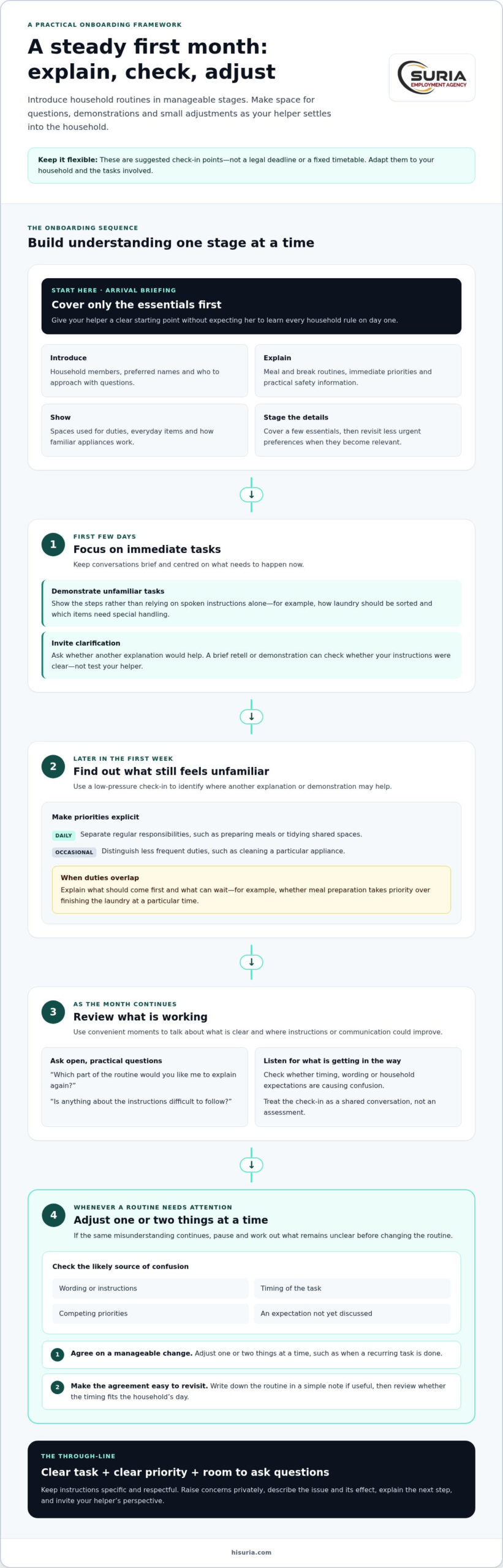
Onboarding continues after the arrival briefing. It develops through demonstrations, check-ins, clarified expectations and small adjustments as your helper gets familiar with the household. The sequence below is a practical framework, not a legal deadline or a timetable every household must follow. Adapt it to your family’s needs and the tasks involved.
Use check-ins to identify what needs clarification
Start by explaining essential routines, then check understanding as your helper puts them into practice. During the first few days, keep conversations brief and focused on immediate tasks. Later in the first week, ask which duties still feel unfamiliar and whether another demonstration would help. As the month continues, use convenient moments to discuss what is working and where instructions or communication could be clearer. These are suggested check-in points, not formal requirements.
Make questions easy to raise. Try asking, “Which part of the routine would you like me to explain again?” or “Is anything about the instructions difficult to follow?” Listen for practical concerns, including whether timing or wording is causing confusion. A check-in should help both of you identify what needs attention, not feel like an assessment.
Adjust routines without losing clarity
If something isn’t working, agree on one or two manageable changes at a time. You might adjust when a recurring task is done, then review whether the new timing fits the household’s day. Changing too many instructions at once can make it harder to tell what helped. If useful, write down the agreed routine in a simple note so both of you can refer to it.
A steady first-month process gives expectations room to become clearer through practice. For questions connected to helper placement, contact Suria for placement guidance.
Know when to seek guidance during maid onboarding
Some uncertainty is part of learning a new household routine. If the same misunderstanding continues after you’ve explained and demonstrated the task, pause to identify what remains unclear. The issue may be the wording, timing, competing priorities or an expectation that hasn’t been discussed. Separate day-to-day adjustments from questions about recruitment or placement arrangements.
Separate placement questions from formal requirements
An employment agency can help clarify placement information and recruitment arrangements. For formal rules, Work Permit conditions and employer obligations, refer directly to the latest Ministry of Manpower (MOM) guidance, as requirements can change. Placement support can address recruitment-related questions, but it doesn’t replace your responsibilities as an employer.
Suria Employment Agency has operated since 2002 and holds MOM Employment Agency Licence 02C2836. The agency provides placement support, while official MOM information remains the reference for regulatory matters.
Choose a useful next step
Before seeking help, write down the issue, what you’ve already explained and the specific clarification you need. Note whether the task was discussed verbally, demonstrated or included in an agreed routine. This gives the conversation a clear starting point and helps distinguish a communication gap from an unresolved placement question.
A practical maid onboarding guide supports clear communication, but it can’t anticipate every household or placement concern. If your question relates to your helper’s placement, you’re welcome to speak with Suria about placement guidance. Refer to MOM for formal requirements and carry out your employer responsibilities directly.
Build a confident start, one conversation at a time
A thoughtful maid onboarding guide is less about giving every instruction immediately and more about creating a clear process for learning together. Introduce essential routines in manageable stages, demonstrate household-specific tasks and make it comfortable for your helper to ask for clarification. These steps help prevent avoidable misunderstandings.
Keep the first month flexible. Check in, listen to what remains unclear and adjust routines a little at a time. For questions about formal employer requirements, refer to current Ministry of Manpower guidance. Suria Employment Agency can assist with recruitment and placement questions. Suria has operated since 2002 and holds MOM Employment Agency Licence No. 02C2836.
If you have questions about domestic-helper placement, contact Suria Employment Agency. Clear expectations and respectful communication help your household and your helper build a practical working rhythm over time.
Frequently Asked Questions
How do I onboard a new maid in Singapore?
Start gradually with introductions, immediate household routines and essential safety information. Demonstrate unfamiliar tasks, explain which duties take priority when they overlap, and agree on how to ask questions. Check in during the first month and adjust instructions together. Use a practical maid onboarding guide to organise these steps, and refer to current MOM guidance for formal requirements.
What should I explain to a new domestic helper on the first day?
Focus on what she needs to manage the day: who lives in the household, how to address family members, the daily schedule and where commonly used items are kept. Explain immediate safety information and who she can approach if unsure. Keep the first conversation manageable, and introduce less urgent preferences as they become relevant.
How long does it take for a new maid to settle into a household?
There’s no fixed settling-in period that applies to every helper or household. Familiarity develops as routines are practised, questions are answered and expectations become clearer. Use the first month for regular, low-pressure check-ins, but treat the timing as flexible rather than a deadline. Progress depends on the tasks, household routines and how familiar the helper is with them.
How can I communicate household routines clearly to a new helper?
Give one clear instruction at a time and explain the preferred result, especially for household-specific tasks. Demonstrate steps such as sorting laundry or storing food instead of relying on assumptions. Distinguish daily duties from occasional tasks, explain priorities if they conflict, and invite questions. A short written note can help both of you refer back to agreed routines.
What should I do if my new maid does not understand my instructions?
Pause and explain the instruction in simpler, more specific terms. Demonstrate the task if that would help, then ask which part needs clarification. Invite your helper to raise concerns about timing or wording, and don’t assume silence means understanding. If the same confusion continues, review whether the expectation was clear and seek placement guidance if the question concerns placement. Consult MOM for formal requirements.
Disclaimer
The articles published on this website are provided for general informational purposes only. While we strive to keep the information accurate and up to date, we make no warranties regarding its completeness, reliability, or accuracy. Readers should verify information independently and seek qualified professional advice when appropriate. Any reliance on this content is at the reader's own risk.