

The lowest quoted salary can become the most expensive hiring decision if it doesn’t reflect a helper’s experience, skills, or the full cost of employment. If you’re researching the indonesian maid salary 2025, it’s easy to see “market rate” and “minimum wage” used as though they mean the same thing. Singapore doesn’t set a minimum wage for foreign domestic workers, and salary expectations vary by experience and hiring route.
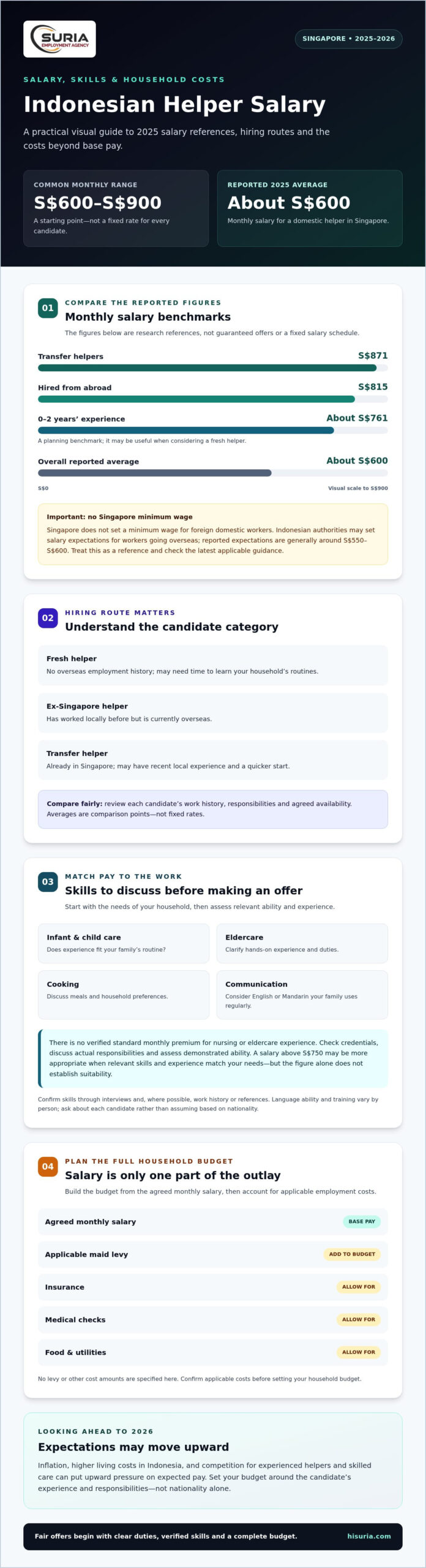
In 2025, the reported average monthly salary for a domestic helper in Singapore was about S$600. Transfer helpers averaged S$871, compared with S$815 for helpers hired from abroad. These figures show why one number can’t describe every household or candidate.
This guide explains how to budget for 2025 and 2026, compare salary expectations for fresh, ex-Singapore, and transfer helpers, and account for costs such as the levy and insurance. It also covers how relevant care experience and other skills can affect a fair offer. Suria Employment Agency has more than 20 years of experience matching families with helpers and handling placement paperwork, helping employers consider both candidate fit and the practical steps involved in hiring.
Key Takeaways
- Use the indonesian maid salary 2025 ranges as a starting point, then adjust your offer for the candidate’s experience and hiring route.
- Identify the skills your household actually needs, such as infant care, eldercare, or cooking, before deciding whether they support a higher offer.
- Budget for the maid levy and other employment costs as well as base pay.
- Set clear expectations and agree on fair compensation and any incentives to support a stable working relationship.
The 2025 Outlook: Current Trends in Indonesian Maid Salaries
The indonesian maid salary 2025 commonly falls between S$600 and S$900 a month. The right offer depends on a helper’s experience and skills, as well as whether she is hired from abroad or transferred from another Singapore employer. Singapore doesn’t set a minimum wage for foreign domestic workers. Indonesian authorities may set salary expectations for workers going overseas, with reported minimum expectations generally around S$550 to S$600. Check the latest applicable guidance before making an offer. Treat that figure as a reference, not as the market rate for every candidate.
Pay expectations are trending upwards in 2026. Inflation can put pressure on the wages workers consider worthwhile, while demand for experienced helpers and skilled care can raise market offers. The wider context of domestic work and Singapore’s foreign domestic worker system is outlined in Foreign Domestic Workers in Singapore. For employers, the practical point is that a minimum expectation may not be enough to secure a high-demand helper with relevant experience.
Why Indonesian Helpers Are a Top Choice in 2025
Some Singaporean households value cultural familiarity and communication in Bahasa Indonesia or Malay, particularly when these suit the family’s daily routines. These qualities vary from person to person, so ask about each candidate’s language ability and household experience rather than making assumptions based on nationality. Training and preparation can also differ. Confirm what a candidate has completed and how it relates to the work your household needs.
The Impact of Global Economics on 2026 Wage Standards
Higher living costs in Indonesia can influence the minimum pay a prospective helper is willing to accept. Competition for proven care skills may also affect offers in Singapore. Set your budget based on a candidate’s experience and the responsibilities involved, not nationality alone.
For planning purposes, the average expected salary for a helper with 0 to 2 years of experience is about S$761 per month. This can be a useful benchmark for a fresh helper with no prior experience.
Key Variables: What Determines an Indonesian Helper’s Pay?
Salary depends on more than nationality. Experience, placement type, communication skills, and the duties your household needs all shape an offer. For context, the research figures show transfer helpers averaging S$871 per month, compared with S$815 for helpers hired from abroad. These are market averages, not fixed rates. Individual expectations can differ, so use them as a comparison point rather than a salary schedule.
Fresh vs. Transfer Maids: The Salary Divide
A fresh helper has no overseas employment history, so she may need time to learn your household’s routines. An ex-Singapore helper has worked locally before but is currently overseas, bringing relevant experience without being a transfer. A transfer helper is already in Singapore and may have recent local experience and a quicker start. These differences can affect salary expectations. Before comparing offers, review each candidate’s work history, responsibilities, and agreed availability in this guide to hiring a transfer maid.
Skill-Based Increments for Specialized Care
There’s no verified standard monthly premium for a nursing background or eldercare experience, so don’t assume a certificate automatically justifies a set increase. Check credentials, clarify the actual responsibilities, and discuss compensation in relation to demonstrated ability. A salary above S$750 may be more appropriate when relevant skills and experience match your household’s needs, but the figure alone doesn’t establish suitability.
- Infant or young-child care experience that fits your family’s routine.
- Hands-on eldercare experience, with the expected duties clearly discussed.
- Cooking skills that suit your household’s meals and preferences.
- English or Mandarin communication skills your family will use regularly.
Assess each skill during interviews and, where possible, confirm it through work history or references. Language ability can make daily instructions smoother, but its value depends on your household and doesn’t guarantee a particular pay premium. If you’re comparing new and transfer placements, explore Indonesian helper placement options with Suria Employment Agency, which has more than 20 years of experience matching Singaporean families with Indonesian helpers.
Calculating the Total Monthly Outlay for 2025 and 2026
The indonesian maid salary 2025 is only one part of your household budget. Start with the agreed monthly salary, then add the applicable levy and set aside funds for insurance, medical checks, food, utilities, and personal care items. These living costs vary by household, so estimate them using your family’s actual spending rather than a generic figure.
The MOM Levy and Your Eligibility for Concessions
In 2026, the standard levy is S$300 per month for a household’s first helper and S$450 for a second or subsequent helper. Eligible households with a child under 16, an elderly person aged 67 or older, or a person with disabilities may qualify for the S$60 concessionary rate. Confirm eligibility and current requirements with MOM. Accurate work permit application paperwork helps ensure the helper’s details are handled correctly, but concession eligibility depends on MOM’s criteria.
Use this structure to estimate your monthly costs:
- Agreed salary plus the applicable monthly levy.
- Insurance and medical expenses, budgeted across the year.
- Food, utilities, and personal hygiene supplies based on your household’s use.
- Any agreed rest-day compensation if the helper works on a rest day.
Helpers are entitled to at least one rest day a week. If both parties agree that the helper will work on a rest day, provide at least a day’s salary or a replacement rest day. Don’t treat the rest day as automatically available for work. Discuss the arrangement and account for its effect on your budget.
Hidden Costs: Insurance, Medical, and Security Bonds
Employers must arrange medical insurance with at least S$60,000 annual coverage for inpatient care and day surgery, personal accident insurance with at least S$60,000 coverage, and a S$5,000 security bond for each helper. A six-monthly medical examination is required every six months, with reported costs of approximately S$35 to S$60 per examination.
For help with the paperwork involved in a placement, review Suria’s helper placement support as you plan your household budget.
Ensuring Long-Term Stability: Fair Pay and Retention
A fair salary supports a stable working relationship, but it can’t guarantee performance or retention. Consider the helper’s experience, responsibilities, and relevant skills when setting pay, then explain expectations clearly from the start. A competitive offer can help reduce avoidable dissatisfaction, while respectful communication and realistic duties matter just as much.
Structuring Incentives for Better Performance
Agree on a review schedule, such as an annual discussion, and consider an increment if responsibilities grow or the helper demonstrates sustained development in agreed duties. If you offer a performance bonus, define the criteria and timing in advance. Keep it separate from base salary so both sides understand what is guaranteed and what is discretionary.
Retention also depends on everyday conditions. Respect agreed rest days, provide suitable food and accommodation, and give clear instructions and constructive feedback. These practices help build trust without relying only on higher base pay.
Plan for the Full Employment Journey
Hiring costs don’t end with placement. Include potential end-of-contract arrangements in your planning, and review the steps involved in cancelling a maid’s Work Permit and arranging repatriation. An experienced maid placement agency can help clarify salary expectations and documentation, reducing the risk of mismatched expectations at the outset.
How Suria Employment Agency Supports Your Hiring Journey
Suria Employment Agency has more than 20 years of experience matching Singaporean families with Indonesian helpers, including new and transfer placements. Considering your household’s needs alongside a candidate’s experience and skills can help you make a more informed initial match. For guidance on hiring and placement, contact Suria Employment Agency to discuss your requirements.
Build a Fair Budget for a Stronger Long-Term Match
A confident hiring decision starts with looking beyond the monthly salary. Use the indonesian maid salary 2025 as a market reference, then compare the candidate’s experience, skills, and placement type with your household’s needs. Include the levy, insurance, medical expenses, and living costs so your budget reflects the full commitment.
Fair pay is only one part of retention. Clear duties, respectful communication, agreed rest-day arrangements, and regular conversations about performance can all support a stable working relationship. Review compensation as responsibilities and skills develop, and plan ahead for the paperwork and arrangements involved at the end of employment.
Suria Employment Agency has more than 20 years of placement experience and specializes in matching Singaporean families with Indonesian domestic helpers. As a MOM-licensed agency, it handles placement documentation and supports families through important employment processes. Choose a helper with care, set expectations clearly, and start your search for an Indonesian helper with Suria Employment Agency.
Frequently Asked Questions
What is the minimum legal salary for an Indonesian maid in Singapore for 2025?
Singapore doesn’t set a minimum wage for foreign domestic workers, so there isn’t a Singapore-set legal minimum salary for an Indonesian helper. Indonesia’s wage expectations for workers going overseas are generally reported at around S$550 to S$600 per month, but this is distinct from Singapore’s market rate. Check current Indonesian Embassy guidance and agree on salary and employment terms clearly before hiring.
How much should I pay an Indonesian helper for working on her off-day?
If your helper agrees to work on a rest day, she must receive at least a day’s salary or a replacement rest day. Agree on the arrangement in advance and record it clearly. The exact cash amount depends on the agreed monthly salary and the applicable calculation, so confirm the method rather than assuming a standard figure. A rest day shouldn’t be treated as automatically available for work.
Is there a difference in salary between a fresh Indonesian maid and one with Middle East experience?
There can be a difference, but there’s no fixed, verified premium specifically for Middle East experience. A helper with overseas work history may bring useful skills, yet salary should reflect demonstrated abilities, responsibilities, and references rather than the destination country alone. Ask about her actual duties, experience with similar households, and communication skills, then compare those details with a fresh candidate’s profile before setting a fair offer.
What are the hidden costs of hiring an Indonesian domestic helper besides the salary?
Budget for the monthly levy, insurance, medical checks, and household living expenses. The standard levy is S$300 for the first helper and S$450 for a second or subsequent helper. Eligible households may qualify for S$60. Other costs include a S$5,000 security bond, required insurance coverage, and medical examinations every six months. First-time arrivals also need the Settling-In Programme. Check current requirements with MOM.
Do I need to pay for my Indonesian maid’s passport renewal and home leave?
Don’t assume every passport renewal or home-leave expense is automatically the employer’s responsibility. Confirm the agreed employment terms and relevant requirements before hiring, including who will arrange and pay each cost. Employers are responsible for providing accommodation, food, and medical care. Suria Employment Agency offers passport renewal and endorsement, as well as home-leave processing, to help with these administrative arrangements.
Disclaimer
The articles published on this website are provided for general informational purposes only. While we strive to keep the information accurate and up to date, we make no warranties regarding its completeness, reliability, or accuracy. Readers should verify information independently and seek qualified professional advice when appropriate. Any reliance on this content is at the reader's own risk.