
In this guide (8 sections)
- Key Takeaways
- Difference between placement fees and pre-deployment costs
- Conditions and salary cap for placement fees
- Employer responsibility for placement fees
- What are the typical foreign domestic worker placement fees in Singapore?
- Suria Employment Agency: Work Permit Application and Renewal
- Choose a Clear Next Step for Your Household
- Frequently Asked Questions
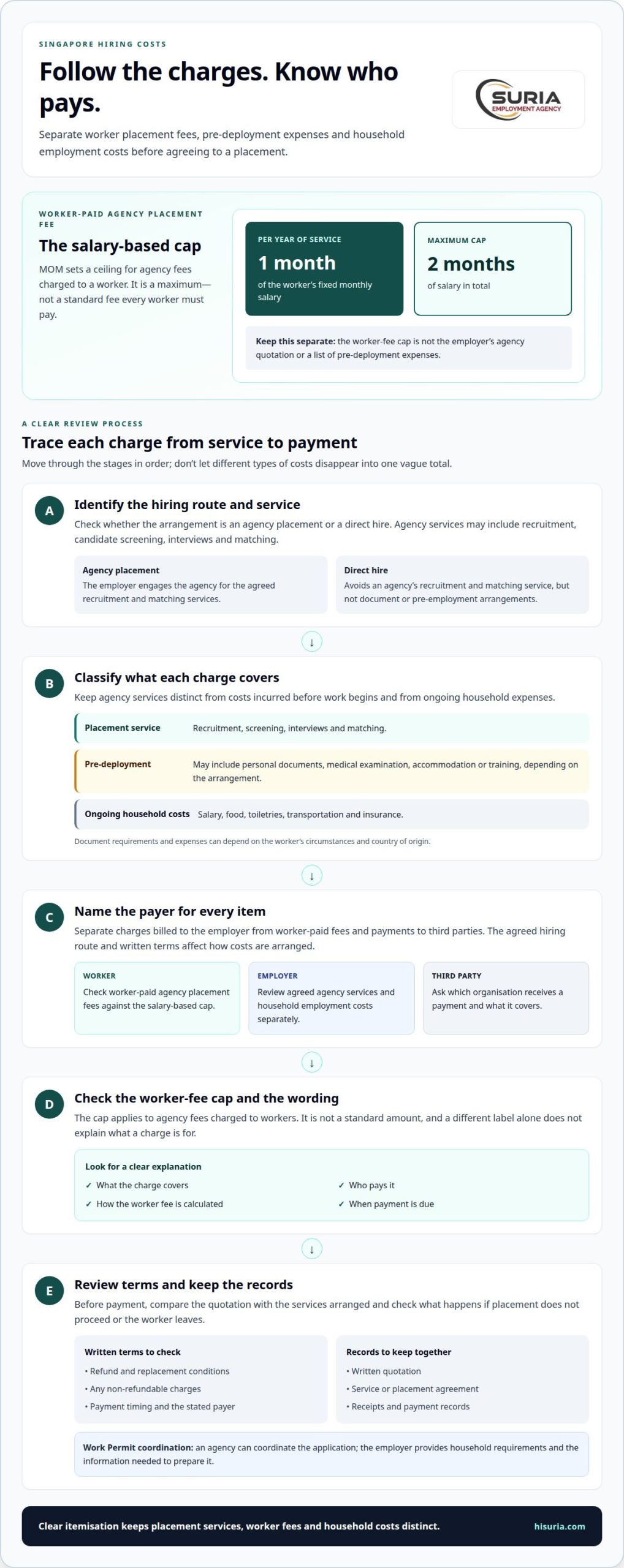
In Singapore, foreign domestic worker placement fees charged to a worker are capped by the Ministry of Manpower (MOM): an employment agency may charge no more than one month of the worker’s fixed monthly salary for each year of service, up to a maximum of two months’ salary. This is separate from costs employers may need to budget for when hiring a helper. Understanding which charges are placement fees, which are pre-deployment costs, and who pays each one helps clarify the total hiring arrangement.
Indonesia’s placement-fee policy may raise additional questions when a helper is recruited from overseas. This article explains how Singapore’s salary-based cap applies, when placement fees may be charged, how they differ from pre-deployment costs, and which expenses employers are responsible for. Understanding how the placement process fits together can help you clarify costs and responsibilities before proceeding.
Key Takeaways
- Learn to distinguish an agency placement fee from pre-deployment expenses, so you can understand what each charge covers.
- According to the Ministry of Manpower, Singapore employment agencies may charge workers no more than 1 month of fixed monthly salary for each year of service, capped at 2 months’ salary.
- Understand how the hiring arrangement affects which costs employers should plan for and how to discuss them clearly.
- See how professional placement and Work Permit support can help organise the hiring process, including when recruiting an Indonesian domestic helper.
Difference between placement fees and pre-deployment costs
A placement fee covers an agency’s recruitment and matching services. Pre-deployment costs are separate expenses incurred before a migrant domestic worker starts work. Depending on the hiring arrangement, they may include personal documents, a medical examination, accommodation, or training. Distinguishing these costs helps employers see which charges are for agency services and which relate to preparing the worker for employment in Singapore.
Personal documentation may include a passport application or renewal and other documents needed for recruitment. Requirements and related expenses depend on the worker’s circumstances and country of origin. For example, documents issued by Philippine authorities apply to applicants from the Philippines, not every worker recruited for Singapore. Ask for document expenses to be itemised separately from the agency’s placement charge.
Medical examination costs may be treated as an allowable personal expense when the employer does not cover them. Clarify whether the employer or worker pays before treating this as part of the placement fee. Testing and quarantine expenses associated with COVID-19 were specific to the pandemic period; they should not be assumed to represent a current, routine hiring cost.
Hiring directly avoids an agency’s recruitment and matching service, but not expenses for documents or pre-employment arrangements. With an agency placement, the employer engages the agency for recruitment and matching; pre-deployment costs depend on the agreed arrangement. The written agreement should set out refunds or replacement terms, including what happens if placement does not proceed or the worker leaves. For the Work Permit process, the agency can coordinate the application, while the employer provides household requirements and the information needed to prepare it. Budget separately for one-time hiring expenses and ongoing employment costs.
Conditions and salary cap for placement fees
MOM caps agency fees charged to workers according to their fixed monthly salary and service period. This is a ceiling, not a standard fee that every worker must pay. Assess the actual fee against the employment arrangement, and distinguish it clearly from charges billed to the employer or expenses paid to third parties.
Ask for the worker’s fee to be itemised separately from the employer’s placement charges. A written breakdown should state what each charge covers, who pays it, and when payment is due. For example, an agency service charge and a document-related expense should not be grouped under a vague label that obscures their purpose.
Excessive or undisclosed charges can raise compliance concerns and leave workers uncertain about what they owe. Renaming a charge does not explain whether it falls under the applicable fee limit. Employment agencies should clearly explain the basis for worker-paid charges, rather than relying on informal explanations or verbal assurances.
Before paying, request the written quotation and service agreement, and review the fee and refund terms. Check that they identify the payer, the service or expense, when payment is due, and the conditions that apply if placement does not proceed. Keep the agreement, receipts, and payment records together. If a proposed worker-paid charge is unclear, request its purpose and calculation in writing before accepting the arrangement.
Employer responsibility for placement fees
In Singapore, employers should understand which charges are payable by the household and which by the worker. Employer-facing agency charges depend on the services and terms agreed for the placement. Request a written breakdown that separates recruitment, matching, and administrative work. This makes it easier to distinguish agency charges from government payments or other third-party expenses.
Agencies may charge employers for agreed placement services, but the quotation should specify what those charges cover. A new overseas placement and a transfer placement, for example, involve different recruitment arrangements. The listed services and costs should match the hiring route. Don’t assume that every item labelled “processing” is a government fee; ask which organisation receives the payment and what it covers. Keep the quotation and receipts with the placement agreement.
An employer’s budget extends beyond the agency’s invoice. Salary, food, toiletries, transportation, and insurance are separate costs associated with employing a domestic worker, and are not automatically part of the placement fee. List them separately in your budget, and check whether the quotation includes any third-party expenses or whether those are paid separately. This prevents one-time hiring costs from being confused with ongoing household expenses.
Before agreeing to charges, clarify who pays each item, when payment is due, and what happens if placement does not proceed. Written terms should explain refund conditions and identify non-refundable charges. Keep receipts and payment records, particularly when costs arise at different stages. Clear documentation helps employers compare the agency’s services with the overall hiring budget, without confusing worker-paid fees with household charges.
There is no single cost breakdown for every hiring route. The amount an agency charges an employer depends on the services and scope set out in the agreement, separately from worker fees and third-party expenses. Review every line before payment and compare it with the services arranged for the placement.
What are the typical foreign domestic worker placement fees in Singapore?
There is no single placement price for every Singapore household. A quotation depends on the hiring route and the recruitment services included. Sourcing, candidate screening, interviews, and matching are distinct parts of an agency’s work, so the proposal should specify which activities it covers. The total also depends on whether the helper is recruited from overseas or is already in Singapore.
Compare quotations by scope, not just by the headline total. One proposal may include candidate matching and hiring coordination, while another lists administrative work separately. If paperwork or third-party expenses are included, check that each item identifies its purpose and payer. This helps distinguish agency service charges from expenses incurred elsewhere in the recruitment process.
The most useful comparison is between arrangements that meet the same household needs. An overseas hire and a transfer helper, for example, involve different recruitment circumstances. Ask how the quoted services reflect the hiring route, which tasks are included, and what may be charged separately. Don’t assume similar totals cover identical work; compare service descriptions and payment terms to understand each quotation.
Before deciding, request the full quotation and agreement in writing. Review the payment schedule, included services, separately billed expenses, and refund conditions if placement does not proceed. Keep these documents together and compare the agreed scope with the services arranged. A clear breakdown is more useful for budgeting than an unexplained total and shows which parts of the hiring process each charge covers.
For a placement tailored to your household, enquire about domestic helper placement and discuss whether a new or transfer hiring route fits your needs.
Suria Employment Agency: Work Permit Application and Renewal
If you are considering a domestic helper placement, contact Suria Employment Agency to ask whether it can assist with Work Permit applications or renewals. The application and renewal process involves paperwork, and the requirements depend on your circumstances.
Families considering a hiring route can also ask Suria Employment Agency whether it offers new placements or placements for experienced Indonesian domestic helpers. Discussing your household’s needs and the placement arrangement can help clarify the support available and keep agency charges separate from other hiring expenses.
For information about domestic helper placement or Work Permit assistance, contact Suria Employment Agency.
Choose a Clear Next Step for Your Household
Before proceeding, consider what support would help your household with the hiring process. You may be arranging a new placement, considering a transfer, or planning support for a helper already employed. Clarifying your needs helps focus the discussion on the service required and the responsibilities involved. It also provides a practical basis for considering foreign domestic worker placement fees as part of the wider hiring arrangement, rather than in isolation.
Ask Suria Employment Agency whether it can assist with new helper placement, transfer placement, or home leave processing. The services available may depend on your household’s circumstances and needs.
When you are ready to discuss a suitable arrangement, contact Suria Employment Agency. A considered next step can help you move forward with greater clarity.
Frequently Asked Questions
What Does Indonesia’s New Placement Fee Policy Mean For You?
Indonesia’s policy introduced a one-time placement fee of S$3,000 for each worker brought into Singapore, starting in January 2021. Its stated purpose was to prevent Indonesian workers from taking on debt before and soon after arrival. For employers, the key point is that this is an Indonesia-related policy figure, not a universal Singapore agency price. Ask how any origin-country charge is treated in the written cost breakdown.
What is the legal cap on employment agency fees for hiring a migrant domestic worker in Singapore?
According to the Ministry of Manpower, Singapore employment agencies may charge workers no more than 1 month of fixed monthly salary for each year of service, capped at 2 months’ salary. This is a ceiling on worker-paid agency fees, not a standard fee that every worker must pay. The amount charged must be considered against the worker’s fixed salary and service arrangement.
What fees can domestic workers be charged, and are there limits on deductions from their salary?
MOM’s placement-fee cap applies to agency fees charged to workers. It does not, by itself, permit an agency to recover other charges through salary deductions. Treat upfront payments and salary deductions as separate matters. Before agreeing to a deduction, identify its purpose and assess it against applicable MOM requirements and the employment terms. Don’t assume that the placement-fee cap allows it.
What other upfront costs apply when hiring a migrant domestic worker in Singapore, including the work permit, levy, insurance and medical examination?
Budget separately for Work Permit processing, the recurring levy, insurance, and medical examination expenses. These have different purposes and should not be grouped as one placement charge. The levy continues during employment, while some hiring expenses arise during processing or before work begins. Medical examination costs may be an allowable personal expense if the employer does not cover them. Ask for each amount and payer to be clearly identified.
What are the rules for refunds or replacement if a domestic worker leaves or is unsuitable?
The written agreement should explain refund or replacement terms, including what happens if the worker leaves or the placement does not proceed. Review the conditions and any non-refundable charges before paying.
What risks or penalties apply to excessive, undisclosed or illegal domestic worker placement fees?
In Singapore, worker-paid placement fees must not exceed one month of fixed monthly salary per year of service, capped at two months’ salary; excessive or undisclosed charges can raise compliance concerns. Under the stated Philippine rules, agencies or employers charging illegal or excessive recruitment fees may face fines of up to ₱2 million, license suspension or cancellation, and possible criminal charges or imprisonment.
Disclaimer
The articles published on this website are provided for general informational purposes only. While we strive to keep the information accurate and up to date, we make no warranties regarding its completeness, reliability, or accuracy. Readers should verify information independently and seek qualified professional advice when appropriate. Any reliance on this content is at the reader's own risk.
Need help hiring a helper?
Our consultants will shortlist suitable helpers and handle the MOM paperwork for you.