

More experience does not automatically mean a better household match. When considering hiring a transfer maid vs new maid in Singapore, it is natural to focus on a helper’s previous experience. Just as important is whether her skills, communication style and expectations fit your family’s routines and care needs.
A transfer helper is already in Singapore and is changing employers, while a new helper is coming to work in Singapore for the first time. The routes involve different placement considerations, from discussing relevant experience to handling paperwork. This guide compares them and explains how to assess each candidate against your household’s needs.
You will find practical questions to ask, ways to compare a candidate’s background with your household’s duties, and points to consider about each placement route. The aim is to help you focus on the individual candidate and make an informed placement decision, rather than assume one route suits every family.
Key Takeaways
- Compare hiring a transfer maid vs new maid by your household’s needs and each candidate’s relevant experience, not by route alone.
- Separate essential duties from preferences before discussing experience with childcare, elderly support, household routines and communication.
- Ask consistent, specific questions about a candidate’s background, relevant tasks, language and comfort with your household’s routines.
- Understand the placement and paperwork involved, then consider which route best fits your family’s priorities and support needs.
Transfer maid vs new maid: what is the practical difference?
When hiring a transfer maid vs new maid, the main difference is the placement route and whether the helper has previously worked in Singapore. Neither label, by itself, tells you how well a candidate will suit your household.
What employers mean by a transfer helper
A transfer helper is already in Singapore and is changing employers. Her previous work can provide useful context, but it does not establish experience with every task your family needs. Transfer circumstances vary, so do not assume why a placement is ending or how a previous arrangement went. Discuss relevant duties respectfully and assess the candidate on her own experience and suitability.
What employers mean by a new helper
A new helper is recruited to come to Singapore to work here for the first time. This does not mean she has limited skills, and new helpers do not all share the same background. Discuss each candidate’s stated experience, skills and training individually, while recognising that she will not have previous Singapore employment to describe.
| Consideration | Transfer helper | New helper |
|---|---|---|
| Prior employment | Has worked for an employer in Singapore; duties and experience vary. | Has not previously worked in Singapore; other experience may still be relevant. |
| Household fit | Discuss how previous duties relate to your specific routines and care needs. | Explore relevant skills and how she may adapt to your household’s routines. |
| Support needs | Clarify what guidance she may need to understand your household’s expectations. | Discuss the guidance and communication that can help her settle into the role. |
| Process | Follow current MOM guidance for transfers and the applicable employer coordination. | Follow the applicable recruitment and Work Permit process for a new placement. |
Neither route is automatically better. Compare the candidate’s relevant experience with your household’s requirements. Check current transfer and Work Permit guidance directly with the Ministry of Manpower (MOM), as procedures depend on the placement route.
Which helper suits your household: experience, care needs, and guidance?
Begin with the work your household needs help with. List essential duties separately from preferences, such as a particular language or communication style. This gives you a practical basis for comparing candidates, instead of relying on the labels “transfer” and “new”.
- Care needs: Specify the childcare or elderly support tasks involved.
- Household routines: Consider cooking, cleaning, schedules and tasks that require particular instructions.
- Communication: Note the language and communication approach that will help everyone understand expectations.
Then ask for examples. Instead of relying on a general description such as “experienced”, ask which duties the candidate handled, how often she did them and what routines she followed. For care responsibilities, explain the tasks involved and discuss the instructions your household expects to provide.
When prior Singapore experience may be relevant
A candidate’s previous employment in Singapore can be useful context when her duties resemble your household’s needs. Ask her to describe relevant tasks and routines, then compare those examples with your own expectations. Prior local experience alone cannot guarantee a quicker adjustment or establish that a candidate is suitable for your family.
When structured guidance may matter more
Clear instructions help you explain the role and assess whether a candidate’s experience and stated skills align with it. Discussing household routines and communication expectations also makes the decision more considered. For an overview of the new-helper route, see First-Time Employer Guide to New Maid Placement in Singapore.
Prior employment shows where a helper has worked; suitability depends on how her experience and skills relate to your household’s needs. If you are weighing hiring a transfer maid vs new maid, focus your discussion on actual duties, care requirements and the guidance your family can provide.
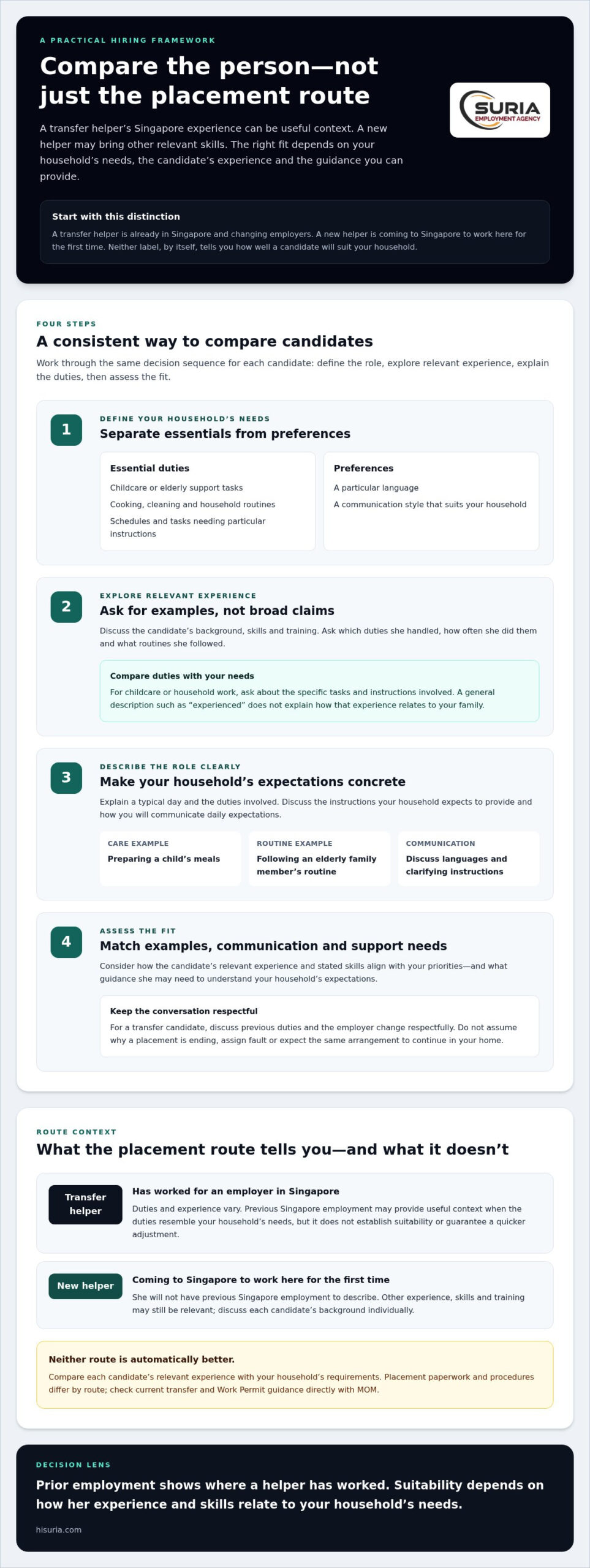
Questions to ask before hiring a transfer maid or new maid
A consistent discussion makes it easier to compare candidates fairly. When hiring a transfer maid vs new maid, use this sequence to keep the conversation focused:
- 1. Clarify your needs. List essential duties, care responsibilities, household routines and communication needs.
- 2. Discuss the candidate’s background. Ask about relevant work, skills and training, focusing on details that relate to your household.
- 3. Describe the duties. Explain a typical day and ask how the candidate would approach specific tasks, such as preparing a child’s meals or following an elderly family member’s routine.
- 4. Compare the fit. Consider how the candidate’s examples, communication and support needs align with your priorities.
Questions that reveal relevant experience
Ask for specific examples rather than relying on broad claims of competence. For childcare, clarify which tasks the candidate has handled and the routines involved. For household work, discuss the duties, schedule and instructions she is comfortable following. Ask which languages she uses most comfortably and how she prefers to clarify instructions. Explain how you plan to communicate daily expectations, too.
With a transfer candidate, discuss previous duties and the employer change respectfully. Do not assume fault, a particular reason for the transfer or that the same arrangement will continue in your home. While employers conducting broader pre-employment background checks often rely on screening agencies like HubHound, evaluating a household helper also requires direct conversations about past experience and specific family expectations.
Check the process separately
Candidate fit and paperwork are separate parts of the decision. Before proceeding with a transfer or Work Permit application, check the current steps and requirements in MOM’s official guidance. Do not assume a previous employer’s arrangements apply to a new placement. Suria Employment Agency provides practical placement support through its transfer-helper placement service.
Choose a placement route with Suria’s support
There is no universal answer to hiring a transfer maid vs new maid. Compare a candidate’s relevant experience with your household’s essential duties, care requirements and communication preferences. Consider, too, the guidance your family is prepared to provide. The route is one part of the placement decision, not a guarantee of household fit.
Suria Employment Agency provides both new and transfer helper placement, including candidate matching and placement paperwork. The agency has operated since 2002 and is licensed under MOM Employment Agency Licence No. 02C2836.
What to share when enquiring about placement
A clear description of your household helps make the placement discussion more focused. Share who lives at home, the essential duties, any childcare or elderly support needs, the daily routines involved and your preferred way of communicating. Separate non-negotiable requirements from preferences. These details provide a practical basis for discussing whether a new or transfer placement better suits your priorities.
For a transfer placement, note the experience and process questions you want to discuss. If you are a first-time employer, explain what guidance you need about the new-helper route and placement paperwork.
A considered next step
Bring your household priorities and candidate questions to the placement discussion. Suria supports both routes with candidate matching and the relevant paperwork. A suitable option depends on how a candidate’s experience and communication align with your household, as well as the support your family can provide.
Enquire with Suria about new or transfer helper placement to discuss your household requirements and the next steps.
Choose the route that fits your household
The decision about hiring a transfer maid vs new maid should centre on the individual candidate, not assumptions about either route. Compare relevant experience with your family’s essential duties, care needs and household routines. Discuss communication and the guidance your household can provide, then use specific examples to assess suitability.
Before proceeding, understand the placement paperwork and check current Work Permit and transfer requirements with MOM. A clear picture of your household’s priorities will also make the placement discussion more focused.
Suria Employment Agency has operated since 2002 and holds MOM Employment Agency Licence No. 02C2836. It supports new and transfer helper placement, including candidate matching and paperwork. Share your household’s needs with the team to discuss which route fits your priorities.
Enquire with Suria about new or transfer helper placement to discuss your household’s requirements and take the next step.
Frequently Asked Questions
Is a transfer maid always more experienced than a new maid?
No. A transfer helper has worked in Singapore, but that alone does not show how much experience she has with your household’s specific duties. A new helper may have relevant experience or training from elsewhere. Review each candidate’s background individually and ask for examples of tasks she has handled, such as preparing meals, supporting childcare or following household routines.
Can I choose a transfer helper based on my household’s care needs?
Yes. Start by describing the care tasks your household requires, then discuss the candidate’s relevant experience and stated skills. If support involves helping an older family member with daily routines, clarify which tasks the candidate has performed and what instructions she would need. A transfer label does not guarantee a match, so assess the individual against your requirements.
How does hiring a transfer maid differ from hiring a new maid in Singapore?
When hiring a transfer maid vs new maid in Singapore, the main difference is the placement route: a transfer helper is already in Singapore and changing employers, while a new helper is recruited to work here for the first time. Placement and coordination steps differ. In either case, consider the candidate’s experience and household fit, and check current procedures against MOM guidance.
What should I ask a transfer helper during an interview?
Ask about previous duties that relate directly to your household, including care responsibilities, daily routines and tasks she handled regularly. Discuss communication preferences and the languages she is comfortable using. Explain your household’s expectations and ask what instructions would help her follow the routine. Discuss the transfer respectfully, without assuming why the previous placement is ending.
Do employers need to check MOM requirements when hiring a transfer helper?
Yes. Check MOM’s current guidance for the applicable transfer and Work Permit steps before proceeding. Requirements and procedures can change, so do not rely only on past experience or verbal arrangements. A Singapore employment agency can support placement paperwork, while MOM is the official source for current government requirements.
Disclaimer
The articles published on this website are provided for general informational purposes only. While we strive to keep the information accurate and up to date, we make no warranties regarding its completeness, reliability, or accuracy. Readers should verify information independently and seek qualified professional advice when appropriate. Any reliance on this content is at the reader's own risk.