

Paying your helper for every rest day she works may seem flexible, but Singapore’s mandatory rest day rules require her to take at least one rest day each month. That day cannot be replaced with payment. Employers must also provide one rest day each week, with the arrangement agreed mutually. It can be difficult to fit these minimums around a household’s schedule, especially because requirements for migrant domestic workers (MDWs) differ from general Employment Act provisions.
This guide explains weekly and monthly entitlements, when your helper may agree to work on other rest days in return for at least one day’s salary, and how temporary deferments work. You’ll also find practical steps for agreeing on a schedule, recording the arrangement in writing and updating the rest-day information in MOM’s FDW eService. Knowing which requirements apply can help you plan a workable schedule without relying on an arrangement that may not meet MOM rules.
Key Takeaways
- Follow Singapore’s mandatory rest day rules for MDWs rather than assuming general Employment Act provisions set their requirements.
- Build the schedule around the required rest-day minimum. Payment for agreed work cannot replace every rest day.
- Discuss suitable days and full-day or split-day arrangements with your helper before putting the schedule in place.
- Keep a written record of the agreement and check that the rest-day information is updated in MOM’s FDW eService.
Mandatory rest day rules for domestic helpers in Singapore
For a migrant domestic worker (MDW), a rest day is the weekly period of time off provided under Singapore’s MDW-specific Work Permit rules. The employer and helper must mutually agree on the day. It does not have to be Sunday, so you can discuss a day that works for your household while ensuring your helper has a clear, regular break. The broader category of migrant domestic workers includes people who move across borders for domestic work, but Singapore’s local requirements are set by MOM.
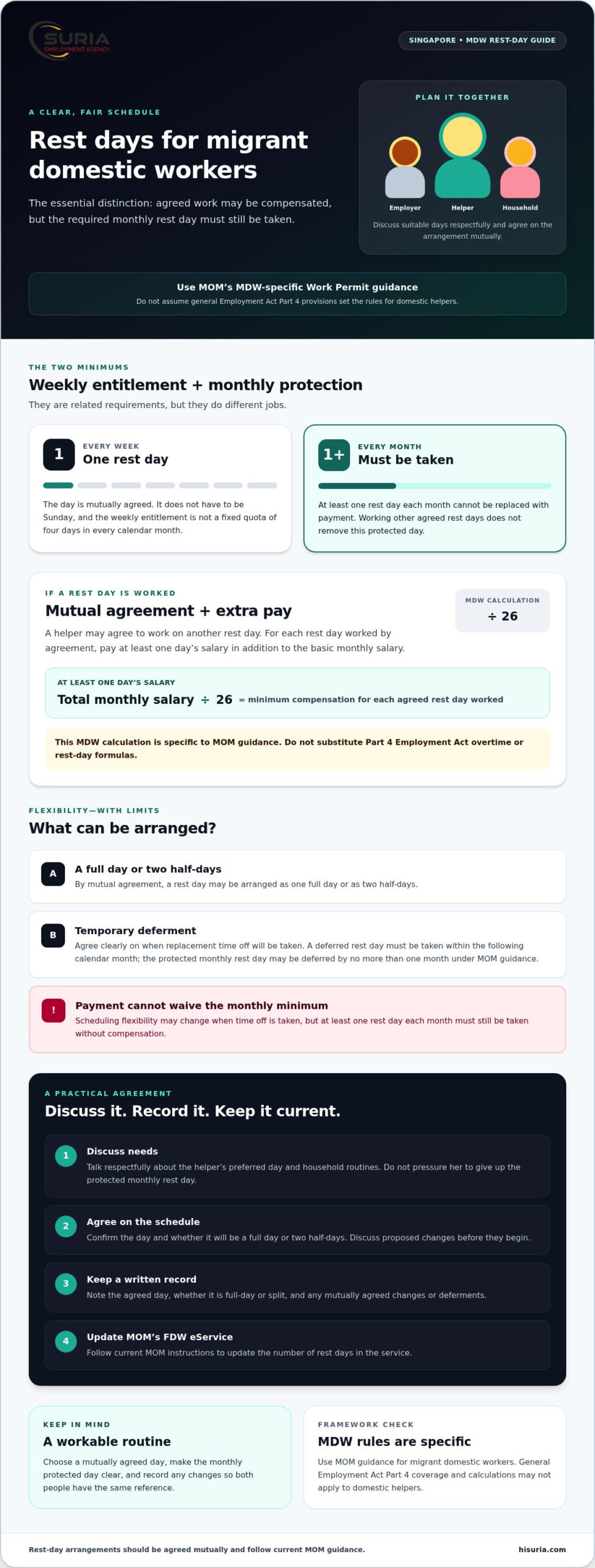
MOM’s current guidance requires one rest day each week and at least one rest day each month that the helper must take and cannot be compensated away. These requirements are related, but the monthly minimum is a specific safeguard. Paying your helper for working on other rest days does not remove the requirement to provide this non-compensable day.
How many rest days must an employer provide?
Provide one rest day per week on the day agreed with your helper. Do not treat this as an exact quota of four days in every calendar month: the weekly entitlement is the rule, and months do not all contain the same number of weeks. Separately, ensure that your helper takes at least one rest day each month rather than exchanging it for payment. Discuss any other arrangement with her and get mutual agreement; do not assume she has agreed.
Why the Employment Act page may not answer an MDW question
MDW rest-day requirements come from MOM’s Work Permit guidance, not automatically from the general provisions for employees covered by Part 4 of the Employment Act. Part 4 has its own coverage rules, so its calculations and examples may not apply to domestic helpers. When checking an arrangement, use MOM guidance specifically for MDWs. Starting with the right framework makes these mandatory rest day rules easier to apply.
Can a domestic helper’s rest day be compensated or deferred?
Your helper may agree to work on a rest day, but the agreement must be mutual and follow MOM’s MDW requirements. For each rest day worked by agreement, you must pay at least one day’s salary in addition to the basic monthly salary. MOM’s MDW guidance calculates this as the total monthly salary divided by 26. This is a specific MDW calculation, so do not substitute Part 4 Employment Act overtime or rest-day formulas.
Payment does not replace the monthly protected rest day. Your helper must take at least one rest day each month, and that day cannot be compensated away.
| Arrangement | What it means |
|---|---|
| Rest taken | The helper has time off on the agreed day. |
| Agreed work with compensation | The helper agrees to work on another rest day and receives at least one day’s salary in addition to basic salary. |
| Permitted deferment | A deferred rest day must be taken within the following calendar month. Deferment should be temporary, and the protected monthly rest day may be deferred by no more than one month under MOM guidance. |
Can a rest day be split or deferred?
By mutual agreement, MOM allows a rest day to be arranged as one full day or two half-days. If a rest day needs to be deferred, agree clearly on when the replacement time off will be taken. Check current MOM guidance for the conditions that apply before making the change.
Flexible scheduling can change when a rest day is taken, but it cannot waive the monthly minimum that must be taken without compensation. Keep that distinction clear when discussing the schedule. If you’re arranging a new or transfer helper, rest-day expectations are also useful to raise during helper placement discussions.
How to agree, schedule, and record rest days in Singapore
A clear routine makes the mandatory rest day rules easier to follow and helps prevent misunderstandings. Use this sequence to agree on the arrangement and keep a record:
- Discuss needs: Talk respectfully about your helper’s preferred day and household routines. Do not pressure her to give up the monthly protected rest day.
- Agree on the schedule: Confirm which day she will take off and whether it will be a full day or two half-days. Discuss proposed changes before they begin.
- Record the terms: Keep a written record of the agreed day, whether it is a full day or split, and any mutually agreed changes or deferments.
- Check MOM’s service: Follow current MOM instructions to update the number of rest days in the FDW eService.
A practical schedule employers and helpers can understand
Make the written record specific. Note the agreed rest day and whether your helper will take it as one full day or two half-days. If household needs change, discuss the adjustment with her, agree on it together and record the revised arrangement. This gives both of you a clear reference, while leaving room for direct, respectful communication.
Where to check or update the arrangement
Use MOM’s FDW eService to update the rest-day information as directed in its employer guidance. If circumstances change or a day needs to be deferred, check the latest MOM instructions before making the change, then record what you have agreed. Families still considering their hiring arrangements can use the first-time employer guide to maid placement to prepare questions, including questions about rest-day expectations. You can also ask about helper placement support. MOM remains the authority for current requirements.
What employers should do next about mandatory rest day rules
Before finalising an arrangement, check that the schedule meets the MDW-specific requirements. Paying for every rest day your helper works does not automatically satisfy the rules. At least one rest day each month must be taken and cannot be replaced by payment.
A simple compliance check before finalizing the arrangement
- Confirm the minimum: Make sure you understand the weekly rest-day entitlement and the monthly non-compensable rest day.
- Agree on the details: Discuss the schedule with your helper, including any agreed work, compensation, split days or deferments.
- Keep a written record: Note the agreed arrangement and any changes so you both have a clear reference.
- Check current MOM guidance: Confirm compensation and scheduling details against MOM’s latest MDW instructions. If your circumstances are unclear, seek clarification from MOM rather than relying on general Employment Act examples.
When placement support may be useful
If you’re hiring a new helper, discuss rest-day expectations during the placement process so you and your helper can start with a clear understanding. Suria Employment Agency can provide support with helper placement, but it is not a government authority or a substitute for MOM guidance on legal requirements.
For questions about whether a particular rest-day arrangement meets the rules, check directly with MOM. A mutually agreed schedule and accurate records help both employer and helper understand the arrangement.
Put a clear rest-day arrangement in place
Singapore’s mandatory rest day rules set a clear starting point: provide a weekly rest day and ensure that your helper takes at least one rest day each month, not exchanged for pay. If she agrees to work on other rest days, confirm the applicable compensation requirements with MOM. Then agree on a workable schedule together, record the terms and keep the FDW eService information up to date.
Discussing rest-day expectations during hiring can help establish clear communication from the start. Suria Employment Agency, a MOM-licensed employment agency (licence 02C2836) operating since 2002, provides new and transfer maid placement services. For support with the placement process, contact Suria Employment Agency about maid placement. For questions about your obligations, rely on current MOM guidance.
Frequently Asked Questions
How many rest days is a domestic helper entitled to in Singapore?
A migrant domestic worker is entitled to one rest day per week, with the day agreed mutually by the employer and helper. Employers must also ensure she takes at least one rest day each month that cannot be compensated away. These mandatory rest day rules apply specifically to MDWs. Check current MOM guidance for details that may affect your arrangement, including how to handle a schedule change or other special circumstances.
Can I pay my helper instead of giving her a rest day?
Your helper may agree to work on a rest day, and you must provide at least one day’s salary for that work. Payment cannot replace every rest day: at least one rest day each month must be taken and cannot be compensated away. Confirm the current MOM instructions for calculating payment, and make sure any agreement to work is genuinely mutual.
Can a domestic helper take her rest day in two half days?
Yes. MOM guidance allows an agreed rest day to be taken as one full day or over two half-days. Discuss the timing with your helper before the arrangement begins, then record what you have agreed so the schedule is clear to both of you. Splitting a rest day does not remove the requirement for at least one monthly rest day that cannot be replaced by payment.
Can an employer defer a domestic helper’s rest day?
MOM guidance allows limited flexibility when a helper cannot take a rest day in a particular month, but deferment is not a routine substitute for time off. Before relying on it, discuss the change with your helper and check current MOM instructions for the conditions and timing. Make sure the monthly non-compensable rest-day requirement is still met, and keep a written record of the agreed arrangement.
Does the Employment Act Part 4 rest-day rule apply to migrant domestic workers?
Employers of migrant domestic workers should follow MOM’s separate MDW rest-day guidance rather than assume that Part 4 provisions apply. The general Employment Act page covers rest-day provisions for employees within Part 4’s limited scope, and its pay calculations may not fit an MDW arrangement. If you’re unsure which guidance applies to your situation, check with MOM before setting or changing the schedule.
Disclaimer
The articles published on this website are provided for general informational purposes only. While we strive to keep the information accurate and up to date, we make no warranties regarding its completeness, reliability, or accuracy. Readers should verify information independently and seek qualified professional advice when appropriate. Any reliance on this content is at the reader's own risk.