

On the first morning, a new helper may be ready to learn while your family has a dozen routines to explain. Trying to cover everything at once can leave both sides unsure what matters most. A practical maid onboarding guide takes a calmer approach: introduce the household gradually, make expectations clear, and leave room for questions.
It’s understandable to want daily tasks handled smoothly from the outset. Unclear instructions can lead to avoidable misunderstandings, but a respectful welcome doesn’t mean lowering expectations. It means explaining them in a way that supports confidence and clear communication. This guide sets out a first-month plan for introducing household routines, agreeing on how to share updates, and checking in as your helper adjusts.
You’ll also learn how to distinguish everyday household guidance from formal requirements. Check formal matters against current Ministry of Manpower guidance and the details of your hiring arrangement. Whether your helper was placed through an agency or hired directly, a steady, two-way introduction can help everyone build a more comfortable working relationship.
Key Takeaways
- Use this maid onboarding guide to welcome your new helper respectfully and introduce household expectations in manageable steps.
- Demonstrate unfamiliar tasks, explain your preferred results, and distinguish daily routines from occasional duties.
- Schedule early check-ins to confirm what’s clear, identify instructions that need repeating, and adjust priorities together.
- If placement or communication questions remain unresolved, consider seeking guidance from Suria Employment Agency, a licensed agency operating since 2002.
Maid onboarding guide: Start with a respectful first-day welcome
Welcoming someone into an established household can feel unfamiliar for everyone. Your family already knows its habits, shortcuts, and preferred ways of doing things. Your new helper is learning them while adjusting to a new home. Treat onboarding as a gradual introduction, not a long briefing that expects someone to remember every detail at once. The broader idea of onboarding is to help a person gain the knowledge and skills needed to settle into a new role.
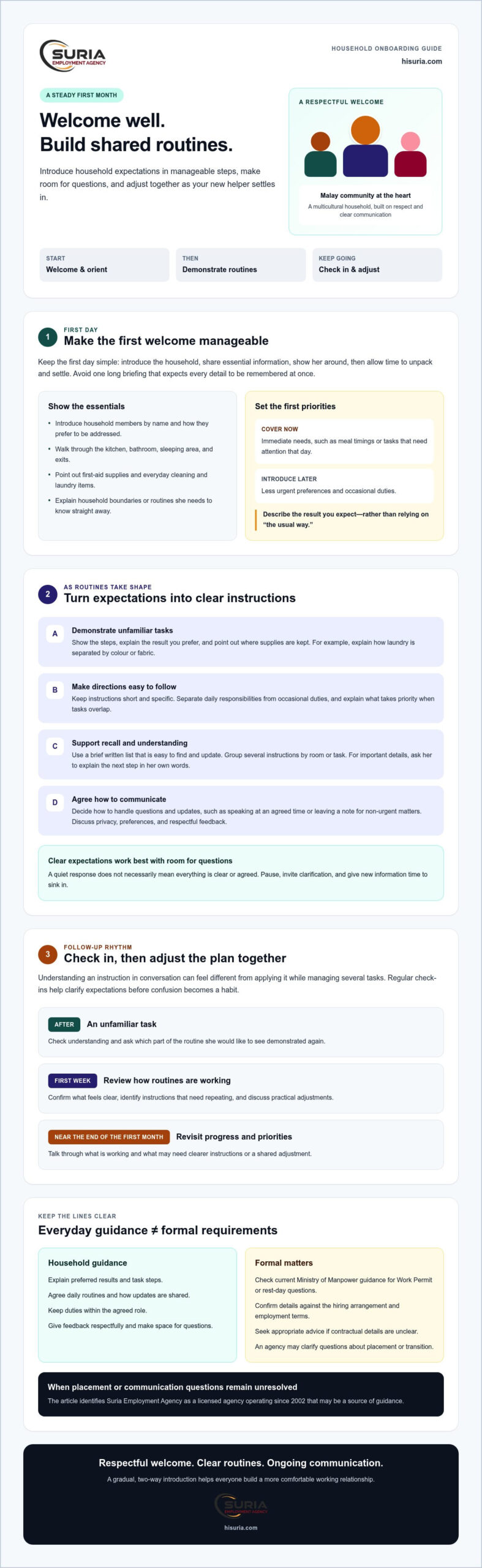
Preparing the home and welcoming your helper are related but distinct. A ready room and organised supplies help before arrival. Once she arrives, clear, respectful communication helps her understand how your household works. Keep the first day simple: make introductions, share essential information, show her around, then allow time to unpack and settle.
What to cover in the first welcome
Introduce household members by name and explain how each person prefers to be addressed. Walk through essential spaces, including the kitchen, bathroom, sleeping area, and exits. Point out relevant safety information, such as where to find first-aid supplies, and show where everyday items like cleaning cloths and laundry products are kept. Explain any household-specific boundaries or routines she needs to know straight away.
Set expectations without overwhelming a new helper
Start with immediate priorities, such as meal timings or tasks that need attention that day. Save less urgent preferences and occasional duties for later conversations. When a task matters, describe the result you expect rather than relying on “the usual way.” For example, explain where an item should go after use or what you mean by a clean surface.
Make space for questions and check understanding gently. You might ask which part of a routine she’d like to see demonstrated again. A quiet response doesn’t necessarily mean everything is clear or agreed. Pause, invite clarification, and give her time to absorb new information. This makes the first day more manageable and gives later conversations a clear starting point.
Build shared routines through clear instructions and communication
Once your helper has settled in, turn household expectations into routines she can follow with confidence. Don’t rely on “you’ll get used to it” for unfamiliar tasks. Demonstrate the steps, explain the result you prefer, and show where the relevant supplies are kept. For example, if you prefer laundry separated by colour or fabric, explain the system and point out where each item belongs.
Make household instructions easy to follow
Keep instructions short and specific. Separate daily responsibilities from occasional duties, and explain what takes priority when tasks overlap. A brief written list can help, especially if it’s easy to find and updated when routines change. If you’re giving several instructions, group them by room or task instead of giving them all at once. When a detail is important, ask your helper to describe the next step in her own words. This checks whether the instruction was clear without making the conversation feel like a test.
Agree on communication and boundaries
Decide how to handle questions and updates, such as speaking in person at an agreed time or leaving a note for non-urgent matters. Discuss privacy, household preferences, and how you’ll share feedback respectfully. A fair working relationship also depends on clear boundaries and respectful treatment, principles reflected in the International Labour Organization’s information on international labor standards.
Use this maid onboarding guide to establish what’s expected, but keep duties within the agreed role. If responsibilities or instructions seem to conflict with the employment terms, don’t rely on assumptions. Check current Ministry of Manpower guidance for questions about Work Permits or rest days, and seek appropriate advice when contractual details are unclear. If a question relates to the placement or transition, the agency involved may be able to clarify the process. This doesn’t replace your responsibility to confirm the arrangement and communicate it clearly.
Use first-week and first-month check-ins to adjust the plan
Clear routines need follow-up. A new helper may understand an instruction during a conversation but find it difficult to apply while managing several tasks. Build check-ins into the settling-in process: check understanding after an unfamiliar task, review how routines are working during the first week, then revisit progress near the end of the first month. This rhythm gives both of you a chance to clarify expectations before confusion becomes a habit.
Questions to use during early check-ins
Keep the conversation calm and practical. Ask which instructions feel clear, which task would benefit from another demonstration, and whether any household routine is difficult to follow. Invite her to raise concerns about communication or practical arrangements. Listen without rushing to correct, then agree on a useful next step, such as demonstrating a task again or clarifying which duty takes priority.
Give feedback privately and focus on a specific action rather than making a personal judgement. For example, explain which part of a routine needs adjusting and what you’d like done differently next time. Recognise improvements clearly, too. A maid onboarding guide should make room for two-way feedback, not just a list of expectations from the employer.
Keep useful notes and check formal requirements
Keep current household instructions, agreed routines, and important contact details somewhere easy to refer to. Update the notes when an arrangement changes so everyone is working from the same information. For formal questions about employment, Work Permits, or rest days, consult current Ministry of Manpower guidance instead of relying on memory or informal advice. Keep agreed responsibilities in view as you adjust household routines.
If a question about placement or the transition remains unclear, ask about maid placement support. Agency guidance can help clarify placement-related questions, while household check-ins and employer responsibilities remain with you.
Know when placement support can help with maid onboarding
Some questions are best handled through a direct conversation at home. If you’ve explained a routine but still disagree about what was agreed, clarify it with your helper first. If the issue concerns placement details, recruitment arrangements, or related paperwork, the agency involved may be able to provide useful context. Seeking guidance early can help distinguish a communication gap from a question about the original placement.
Suria Employment Agency is a MOM-licensed maid placement agency operating since 2002. Its placement and related administrative services may help employers clarify questions during hiring and the transition. Agency guidance can support the process, but it doesn’t replace your responsibility to communicate directly with your helper or meet your obligations as an employer. For questions about current Work Permit conditions or other formal requirements, check the latest Ministry of Manpower guidance.
Prepare useful questions before asking for support
Before seeking help, note what happened, what instructions you’ve already discussed, and what outcome your household needs. Be specific. For example, explain which part of a placement arrangement is unclear rather than describing only a general concern. Separate placement questions from regulatory ones so you can approach the appropriate source and avoid relying on assumptions.
Take a steady next step
Clarifying a concern early is often more constructive than letting uncertainty build. Keep the conversation respectful, involve your helper where the issue affects her work, and confirm any agreed adjustment in a form you can both refer to. If you’re still at the hiring stage, the first-time employer guide to new maid placement can help you understand the earlier steps. For placement-related questions during the transition, contact Suria to ask about relevant guidance. A maid onboarding guide works best when practical household communication and informed placement support each play their proper role.
Build a confident start, one conversation at a time
A steady first month is built through small, clear steps. Welcome your helper respectfully, explain household routines in practical terms, and make space for questions. Demonstrate unfamiliar tasks instead of expecting her to guess, then use check-ins during the first week and month to clarify instructions and adjust routines together.
This maid onboarding guide also reinforces an important balance: agency guidance may help with placement-related questions, but clear communication and employer responsibilities remain yours. For formal matters, refer to current Ministry of Manpower guidance rather than relying on assumptions.
If you have questions about maid placement, Suria Employment Agency may be a helpful point of contact. The agency holds MOM employment agency licence 02C2836 and has operated since 2002. Contact Suria Employment Agency for guidance with maid placement. With a respectful welcome and a willingness to learn from each other, you can help make the transition more settled for everyone.
Frequently Asked Questions
How do I onboard a new maid in Singapore?
Onboard a new helper through a gradual, respectful introduction to your household and clear follow-up conversations. Start with introductions and essential home and safety information, then explain priority tasks and demonstrate unfamiliar routines. Check understanding during the first week and revisit how things are going later in the first month. Separately, verify any orientation or employment requirements that apply to your helper and hiring arrangement with current Ministry of Manpower guidance.
What should I explain to a new domestic helper on the first day?
Explain who lives in the home, how household members prefer to be addressed, and where essential items and spaces are. Cover immediate safety information, the day’s priorities, and any household routine she needs to know straight away. Avoid delivering every preference and occasional duty at once. A calm home orientation, followed by time to settle and ask questions, gives her a clearer starting point.
How long does it take for a new maid to settle into a household?
There’s no fixed settling-in period that applies to every helper or household. Adjustment depends on how familiar the routines are, how clearly expectations are explained, and whether there’s room to ask questions and practise tasks. Treat the first month as a period for learning and regular check-ins, not a deadline for knowing everything. Notice what’s becoming clear and identify where more guidance is needed.
How can I communicate household routines clearly to a new helper?
Give short, specific instructions and demonstrate unfamiliar tasks, including the result you expect. Separate daily routines from occasional duties, and explain which task takes priority if plans conflict. Keep agreed instructions somewhere easy to refer to, and invite questions without assuming silence means understanding. A maid onboarding guide should encourage two-way communication, so check what feels clear and what would benefit from another explanation.
What should I do if my new maid does not understand my instructions?
Pause and explain the instruction another way, then demonstrate the task if that would help. Break it into smaller steps and ask what part remains unclear, without treating the question as a failure. Confirm the next step together and check again later. If confusion concerns placement arrangements, contact the relevant agency for clarification. For formal employment or Work Permit requirements, consult current Ministry of Manpower guidance.
Disclaimer
The articles published on this website are provided for general informational purposes only. While we strive to keep the information accurate and up to date, we make no warranties regarding its completeness, reliability, or accuracy. Readers should verify information independently and seek qualified professional advice when appropriate. Any reliance on this content is at the reader's own risk.