

Imagine waking up on the 18th of the month and realizing you forgot to handle the mom pay levy. For many Singaporean families, the fear that a simple administrative oversight could lead to a revoked work permit is a constant source of silent anxiety. Managing household finances is already a full-time job without the added pressure of strict Ministry of Manpower deadlines. You want to focus on your family’s well-being, not track fluctuating rates or complex eligibility criteria for concessions.
This 2026 guide is designed to simplify the payment process, ensuring you never miss a deadline or overpay. We’ll show you how to transition to a seamless, automated system that keeps your household compliant and your mind at ease. From understanding the current $300 normal rates to mastering the $60 concessionary applications, we’ll walk through every step required to secure your helper’s legal status without the administrative headache. By the end of this article, you’ll have the tools to manage your obligations with professional precision and total confidence.
Key Takeaways
- Identify whether your household qualifies for the $60 concessionary rate or the standard $300 tier to ensure accurate monthly budgeting.
- Set up a GIRO account to automate how you mom pay levy, effectively eliminating the risk of missed payments and administrative penalties.
- Learn how to successfully apply for levy concessions based on the age of your children or elderly family members to reduce your monthly expenses.
- Safeguard your helper’s work permit by maintaining consistent compliance and avoiding the severe legal consequences of levy arrears.
Understanding the Foreign Domestic Worker (FDW) Levy in 2026
The Foreign Domestic Worker levy is a monthly tax that every employer must contribute to the government. Understanding how to mom pay levy correctly is essential for maintaining your helper’s legal status. This system serves as a pricing mechanism to regulate the growth of Foreign Domestic Workers in Singapore, ensuring a balanced workforce. It’s a mandatory payment that doesn’t go to your helper as salary. Your responsibility starts the day the Work Permit is issued. It only ceases when the permit is cancelled or reaches its natural expiration, making it a fixed part of your monthly household management.
Normal vs. Concessionary Levy Rates
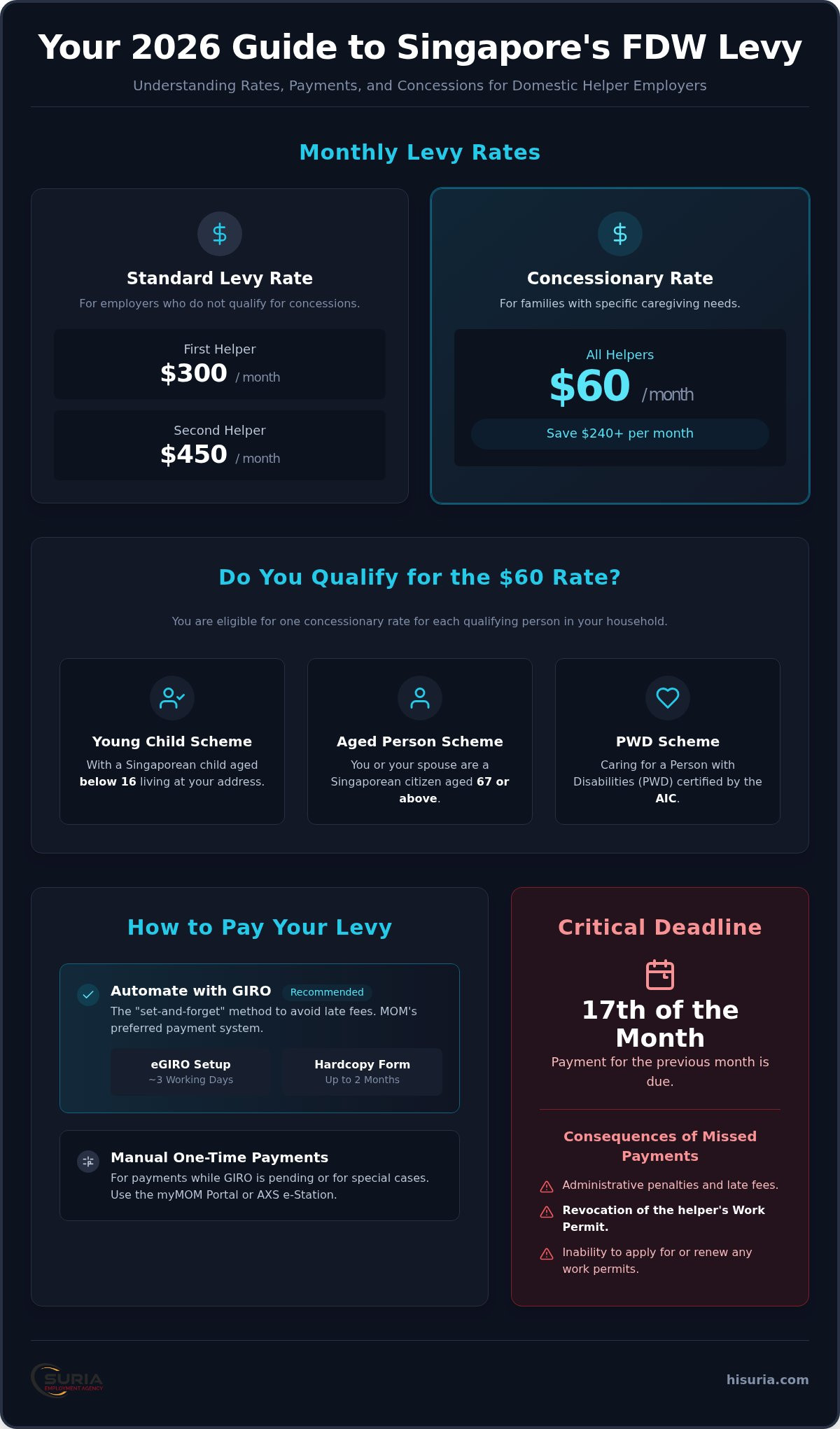
In 2026, standard employers pay $300 monthly for their first helper and $450 for the second. Many households qualify for a reduced rate. The concessionary levy serves as a financial relief for families with caregiving needs. You qualify for the $60 rate with a Singaporean child under 16, an elderly member aged 67+, or a person with disabilities living at your address. This helps you plan your household budget with precision and calm.
Levy Billing Cycles and Deadlines
MOM calculates bills daily for partial months, so you only pay for active employment days. You must pay the previous month’s bill by the 17th of the current month. Using the myMOM Portal to mom pay levy ensures you stay ahead of this critical deadline. Missing this date triggers penalties and risks permit revocation; automated systems are the best way to maintain compliance.
Step-by-Step: How to Pay the MOM Levy via GIRO and eServices
Automating your monthly contributions is the most effective way to ensure your household remains compliant. MOM strongly recommends using GIRO because it functions as a “set-and-forget” system, removing the risk of late fees. It’s also a prerequisite for a smooth administrative cycle; you won’t be able to process a work permit renewal if there are any outstanding levy arrears on your account. Seasoned employers know that keeping these payments current is the foundation of a stable household.
Setting Up Your GIRO Account for Levy
You can initiate a GIRO application easily through the myMOM Portal using your Singpass. Choosing eGIRO is the most efficient route, with a typical processing time of just 3 working days. In contrast, hard copy applications can take up to 2 months to finalize. While your application is pending, you must continue to mom pay levy using manual methods to avoid penalties. To ensure your entire administrative foundation is solid from the start, refer to our 2026 Checklist: Work Permit Application for Domestic Helpers in Singapore.
One-Time Payments via PayNow and AXS
If you need to make a manual payment, the myMOM Portal offers a PayNow QR code option that updates your status almost instantly. Simply log in, navigate to the levy section, and scan the generated code with your preferred banking app. Alternatively, you can use AXS e-Station by selecting ‘Services’, then ‘Government’, and ‘MOM’. You will need your NRIC or FIN number to complete the transaction. For detailed transaction limits and technical requirements, you can consult the official MOM FDW levy information.
Managing these steps correctly from day one prevents future complications. If you find the ongoing administrative requirements overwhelming, our team provides comprehensive support for work permit application and renewal to keep your home running without a hitch.
Strategic Savings: Qualifying for Maid Levy Concessions
Reducing your monthly overhead is a priority for many families. The Ministry of Manpower offers a concessionary rate of $60 to support households with specific caregiving needs. This represents a significant saving from the standard $300 tier discussed earlier. The “Young Child” scheme applies automatically if a Singaporean child under 16 lives with you. For the “Aged Person” scheme, you or your spouse must be a Singapore citizen aged 67 or older. If you care for a person with disabilities (PWD), the Agency for Integrated Care (AIC) must first certify the care recipient’s needs before the lower rate is granted. Each qualifying person allows for one concessionary rate. If your household employs two helpers and has two qualifying individuals, you can enjoy the lower rate for both.
Applying for the Levy Concession
Approval timelines vary depending on the scheme. For automatic categories like young children or elderly citizens, the system usually updates without your intervention. If you need to apply manually through the AIC, the reduced rate typically kicks in on the first day of the month following MOM’s approval. It’s vital to monitor your monthly statements during this transition. To explore the nuances of these savings, read our 2026 Guide to Maid Levy Concession in Singapore: Save on Domestic Helper Costs. This resource provides a deeper dive into eligibility for different family structures.
What Happens if Your Concession Eligibility Changes?
Life transitions can affect how you mom pay levy. When a child turns 16, the system automatically reverts your account to the normal tier. Similarly, if an elderly relative no longer resides at the address or passes away, the concession ends. You don’t usually need to notify MOM for age-based changes, but staying proactive ensures your budget remains accurate. If you’re managing a complex household and need help with work permit application and renewal, our team provides the expert support you need to maintain full compliance.
Troubleshooting and Compliance: What Happens if You Miss a Payment?
A missed deadline can quickly turn into a stressful administrative hurdle for any employer. If you fail to handle the mom pay levy by the 17th of each month, MOM applies an immediate 2% late payment interest. This penalty accumulates monthly, but the financial cost is often less concerning than the legal implications. Continued default leads to the automatic revocation of your helper’s work permit. Once a permit is revoked, your helper can no longer legally work in your home, and you may be barred from hiring a replacement until all debts are settled.
Levy Status and Work Permit Renewals
Maintaining a clean payment history is essential for long term household stability. MOM systems are integrated; they will block any attempt to extend your helper’s stay if there’s an outstanding balance. A clear levy record remains a mandatory prerequisite for all Ministry of Manpower work permit transactions, including new applications and renewals. If you’re approaching an expiry date, consult our 2026 Guide: How to Renew a Maid Work Permit in Singapore to ensure your payments align with the renewal window.
How Suria Agency Supports Your Compliance
We act as a dedicated partner to prevent these bureaucratic headaches from disrupting your family life. Our team monitors permit statuses and alerts you to any administrative flags that could signal a payment issue. If a permit is cancelled due to an oversight, we provide the necessary guidance to rectify the situation or assist with repatriation. In cases where a levy debt makes the employment untenable, you can follow our 2026 Guide: How to Cancel a Maid Work Permit in Singapore. We’re here to ensure your household remains compliant and your helper’s status stays secure.
Securing Your Household’s Future with Seamless Compliance
Managing your domestic helper’s legal status shouldn’t be a source of monthly anxiety. By establishing an automated system via GIRO and verifying your eligibility for concessions, you can transform a complex administrative duty into a “set-and-forget” process. It’s essential to remember that being proactive with how you mom pay levy is about more than avoiding a 2% interest penalty. It’s about protecting the stability of your home and ensuring your helper’s work permit remains compliant for future renewals.
Suria Employment Agency has been an MOM Licensed Agency since 2002, specializing in expert Indonesian and transfer helper placement. We provide full administrative support for renewals and levies, acting as a professional buffer between you and bureaucratic complexities. Let Suria Employment Agency handle your helper’s paperwork so you can focus on your family. With the right expert partner by your side, you can enjoy a harmonious household and total peace of mind.
Frequently Asked Questions
What is the current maid levy rate in Singapore for 2026?
The standard monthly rate for your first domestic helper is $300, while subsequent helpers are charged at $450. If your household qualifies for a concession, the rate drops significantly to $60 per month. These rates are paid directly to the Ministry of Manpower and are separate from your helper’s salary. Ensuring you mom pay levy at the correct rate helps maintain your household budget and legal compliance.
How can I check my foreign worker levy balance?
You can easily view your outstanding balance and payment history through the myMOM Portal using your Singpass login. This digital platform provides a transparent breakdown of your monthly bills and daily calculations for partial months. Regularly checking your account ensures that your payments remain up to date. It also prevents any administrative flags that could interfere with future work permit renewals or other essential documentation for your helper.
Can I pay my maid levy using my Credit Card?
Direct credit card payments aren’t currently a standard option for monthly levy settlements through the myMOM Portal. The Ministry of Manpower prioritizes automated GIRO deductions and PayNow QR codes for their efficiency and speed. While some third-party payment platforms might allow credit card usage for a fee, we recommend sticking to GIRO. This ensures your mom pay levy happens on time every month without the risk of additional service charges.
What happens if my GIRO deduction for the maid levy fails?
A failed GIRO deduction triggers an immediate 2% monthly interest penalty on the outstanding amount. MOM will typically notify you of the unsuccessful transaction, and you’ll need to settle the balance manually via PayNow or AXS before the next deadline. If the debt remains unpaid, the Ministry may revoke your helper’s work permit. Keeping sufficient funds in your linked bank account is the simplest way to avoid these severe consequences.
How do I apply for the $60 concessionary maid levy?
Most concessions for young children under 16 or elderly family members aged 67 and above are applied automatically based on official records. If you’re caring for a person with disabilities, you must submit a manual application through the Agency for Integrated Care. Once certified, the $60 rate usually takes effect the following month. Our team can assist with the administrative steps to ensure your household receives the financial relief you’re entitled to.
Disclaimer
The articles published on this website are provided for general informational purposes only. While we strive to keep the information accurate and up to date, we make no warranties regarding its completeness, reliability, or accuracy. Readers should verify information independently and seek qualified professional advice when appropriate. Any reliance on this content is at the reader's own risk.