

In this guide (8 sections)
- Key Takeaways
- How to apply for a security bond for my domestic worker?
- Security bond insurance application and approval process
- What is a direct-hire security bond in Singapore?
- Who must buy and pay for the security bond, and when must it be submitted?
- Suria Employment Agency: New Maid Placement
- Plan Your Next Hiring Step with Confidence
- Frequently Asked Questions
Direct hiring does not remove Singapore’s security bond requirement. The direct hire security bond rules require employers to buy a S$5,000 bond for each migrant domestic worker, except Malaysian helpers, according to the Ministry of Manpower (MOM). The bond must be in place before the helper arrives, so arranging it is part of preparing for her entry and Work Permit.
It’s understandable to focus on paperwork and approval timing, especially when planning an arrival date. This article explains how to arrange a direct hire security bond, what the insurance approval process involves, and how an insurance-backed guarantee differs from a cash deposit. It also explains the role of the in-principle approval letter in an insurance application.
You’ll learn what the bond covers, when it may be forfeited, and what must happen before the employer’s liability ends. The article sets out the process in practical order, so you can coordinate the bond with other direct-hire arrangements and understand what to expect at each stage.
Key Takeaways
- Prepare the worker-specific in-principle approval letter for an insurance bond application and understand how it fits into the approval process.
- Compare an insurer-backed guarantee with a cash deposit by considering how each secures the bond and affects your available funds.
- Keep the bond acknowledgement and related records organised so you can follow the bond arrangements through the hiring process.
- For support coordinating a new helper’s placement and Work Permit paperwork, consider using an agency that handles these steps.
How to apply for a security bond for my domestic worker?
For a direct hire, the employer arranges the bond as part of the worker’s entry and Work Permit preparations. The requirement applies to Singapore employers hiring migrant domestic workers, not only to agency placements.
Direct-Hire Security Bond Definition
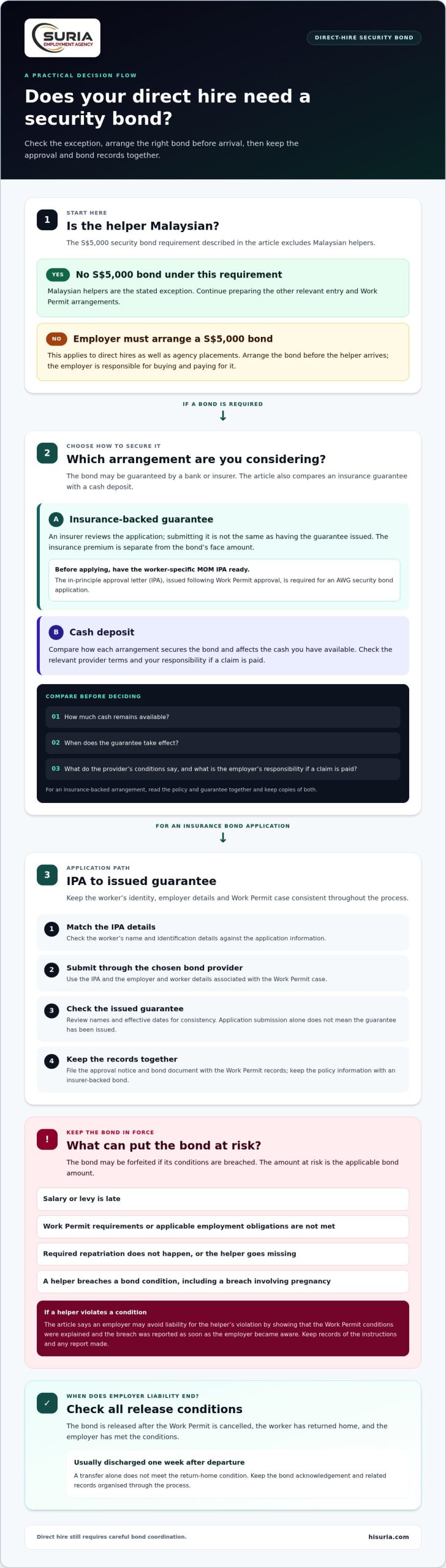
A security bond is a binding guarantee to the Singapore Government that the employer and helper will meet applicable Work Permit conditions. According to the Ministry of Manpower, employers must buy a S$5,000 bond for each migrant domestic worker they employ, except Malaysian helpers. The rule covers direct hires and agency placements alike.
Employer Responsibilities and Bond Conditions
Bond conditions are the responsibilities an employer must meet to keep the guarantee in force. Employers must pay salary and levies on time, follow Work Permit requirements, arrange repatriation when required, and meet applicable employment obligations. The bond may be forfeited if the employer or helper breaches its conditions, salary is late, required repatriation does not happen, or the helper goes missing. The amount at risk is the applicable bond amount.
Liability for Helper Violations
Employer liability refers to the consequences an employer may face when bond conditions are breached. A helper’s violation can put the bond at risk, including a breach involving pregnancy. An employer may avoid liability for a helper’s violation by showing that they explained the Work Permit conditions and reported the breach as soon as they became aware of it. Keep clear records of those instructions and any report made.
Bond Purchase and Submission Requirements
The employer is responsible for buying and paying for the bond; the helper cannot be required to pay. Arrange it before arrival so it is effective when the worker enters Singapore. Log in to WP Online, print the bond acknowledgement letter, and give the helper a copy. The bond is released after the Work Permit is cancelled, the worker has returned home, and the employer has met the conditions. It is usually discharged one week after departure. A transfer does not itself meet the return-home condition. If the worker leaves Singapore, discharge depends on those same conditions.
Security bond insurance application and approval process
An insurance-backed bond application involves an insurer’s review, followed by issuance of the guarantee. Keep these steps distinct: submitting an application does not mean the guarantee has been issued. Organise the documents so the worker’s identity, employer details, and Work Permit case remain consistent throughout.
In-principle Approval Letter
An in-principle approval letter, or IPA, is MOM’s worker-specific letter issued following Work Permit approval. An IPA issued by the Ministry of Manpower for that foreign worker is required for an AWG security bond application. Before submitting, compare the worker’s name and identification details on the IPA with the application. Consistent records help avoid unnecessary follow-up over mismatched information.
Application and Approval Steps
Prepare a file using the IPA and the employer and worker details associated with the Work Permit case. Review every entry before submission, especially names and identifying information. Once the guarantee is issued, compare it with the application and keep the approval notice and bond document with the permit records.
- Match the IPA details against the application information.
- Submit the application through the chosen bond provider.
- Review the issued guarantee for consistent names and effective dates.
- Keep the approval notice and guarantee together for future reference.
Coordinating the bond request with Work Permit paperwork helps keep the document trail organised.
Insurance Guarantee Compared with a Cash Deposit
An insurance guarantee and a cash deposit secure the bond through different arrangements. Compare how much cash remains available, when the guarantee takes effect, the provider’s conditions, and the employer’s responsibility if a claim is paid. The insurance premium is separate from the bond’s face amount. Read the policy and guarantee together because they set out related but distinct terms. Keep copies of both for reference if questions arise during the employment period.
What is a direct-hire security bond in Singapore?
A direct-hire security bond is a formal guarantee made to the Singapore Government in connection with employing a migrant domestic worker. “Direct hire” describes the recruitment arrangement: the employer has identified the worker without using an agency to find her. It does not mean there is a separate type of bond. The bond is a financial undertaking, not an agreement between the employer and helper.
The guarantee may be issued by a bank or an insurer. In practical terms, that institution gives the Government a formal assurance under the bond’s terms. The employer remains responsible for the hiring arrangement that the guarantee supports. This distinction clarifies the roles involved: the employer arranges the employment, the financial institution issues the guarantee, and the Government is its beneficiary.
For a direct hire, keep the bond document with the worker’s other employment records. Check that the employer and worker are correctly identified and that the document refers to the intended hiring arrangement. If the guarantee is insurer-backed, keep the policy information with the bond paperwork. These checks help distinguish the bond from unrelated insurance documents and make the file easier to understand later.
The hiring route and the financial instrument are separate decisions. An employer may identify a worker directly and still use a bank or insurer to provide the guarantee. Conversely, arranging a guarantee does not make the bank or insurer the worker’s employer. The bond is not a placement contract, a helper’s salary, or a general household insurance policy.
Understanding this distinction makes the paperwork easier to organise. Keep records showing which institution issued the guarantee and which employer and worker it names. Treat the bond as its own document rather than assuming another hiring or insurance paper serves the same purpose. This gives employers a clearer record of the arrangement without confusing recruitment with the guarantee itself.
Who must buy and pay for the security bond, and when must it be submitted?
The employer named in the worker’s employment and permit arrangements is responsible for the bond process. A relative or administrator may help organise documents, but the employer should oversee the application and keep the records. This distinction matters in a direct hire, where family members may share administrative tasks while one person remains accountable for the employment arrangement.
Plan submission around the worker’s expected arrival, allowing time for the provider to review the application, issue the guarantee, and correct any discrepancies. An application receipt is not the same as an issued guarantee. Check the document’s effective date against the travel itinerary and resolve any mismatch before the worker travels. This date check is especially useful if flights change after arrangements have begun.
Keep a simple case file for each helper. Include the provider’s correspondence, application details, issued guarantee, and notes about any amendments. Use the same spelling and identifying details throughout the paperwork. If a provider requests a correction, record what changed and retain the updated document rather than relying on an earlier draft.
- Assign oversight. Identify the employer responsible for reviewing the bond application and provider correspondence.
- Coordinate dates. Compare the proposed effective date with the travel itinerary and revise plans if they do not align.
- Review the issued document. Check that the named parties and guarantee details match the intended employment arrangement.
- Maintain the record. Store final documents and later amendments together for reference during employment or permit administration.
When employment arrangements change, review the bond paperwork alongside the updated worker and employer records. This helps distinguish current documents from superseded drafts and keeps the file clear for later administrative steps. The employer remains responsible for this review, even when another person helps with coordination.
Suria Employment Agency: New Maid Placement
Suria Employment Agency supports families arranging a new helper through New Maid Placement and Work Permit Application and Renewal. This is a practical next step when you need help coordinating placement with required employment paperwork, including the Work Permit process. The security bond remains the employer’s responsibility, so plan its arrangement alongside the worker’s entry and permit steps.
For families considering a direct hire, Suria’s Direct Hire Services can assist with the hiring process and related paperwork. Support can also include Home Leave Processing and Renewal & Endorsement of Passports when relevant to the worker’s arrangements. Organising these tasks helps employers track what needs attention during hiring and later employment.
Contact Suria Employment Agency to discuss placement or direct-hire support for your household.
Plan Your Next Hiring Step with Confidence
Once you understand the bond process, list the remaining hiring tasks in the order they need to happen. Keep the Work Permit arrangements, the worker’s arrival plans, and the employer’s responsibilities aligned, and store key documents together for easy reference. A clear plan for managing the direct hire security bond rules helps you make each decision without losing sight of your household’s needs.
Suria Employment Agency offers New Maid Placement and Transfer Maid Placement for families deciding how to hire, along with Home Leave Processing for relevant worker arrangements. Choose the support that fits your next step, whether you’re starting a placement or arranging an existing helper’s leave.
Contact Suria Employment Agency to discuss the hiring support that suits your household. A considered plan can make the next stage clearer and easier to manage.
Frequently Asked Questions
How long do these bonds last?
A security bond remains relevant during the worker’s employment and Work Permit period; it is not simply a fixed-term insurance policy. The employer’s liability ends when the Work Permit is cancelled, the helper has returned home, and the bond conditions have been met. If those conditions are satisfied, the bond is usually discharged one week after the helper leaves Singapore.
What is the cost of the security bonds for domestic workers in Singapore?
The bond amount is the guarantee secured for the Government, while an insurer’s premium is a separate payment for arranging an insurance-backed guarantee. The Ministry of Manpower states the bond amount as S$5,000, except for Malaysian helpers. Premiums are set by the insurer’s product and terms, so don’t treat the bond amount as the insurance premium or assume they are equal.
Which foreign domestic workers require a security bond in Singapore?
Employers hiring migrant domestic workers from outside Singapore generally need a security bond, except for Malaysian helpers. The requirement applies whether the employer hires directly or through an organisation. Choosing a direct-hire arrangement does not itself create an exemption. Identify the helper’s nationality and hiring route early, since these details affect whether the bond requirement applies.
What is the current security bond amount for a foreign domestic worker in Singapore?
According to the Ministry of Manpower, employers must buy a S$5,000 bond for each migrant domestic worker, except Malaysian helpers. Market information also describes a S$7,000 bond for workers from the Philippines. These figures refer to the guarantee amount, not necessarily the insurer’s premium. Distinguish the bond’s coverage amount from the separate cost of arranging insurance.
What are the security bond conditions and employer obligations in Singapore?
Employers must meet the bond conditions relating to salary, levies, repatriation, and Work Permit compliance. Keep employment and payment records to show how you managed these duties. If a helper breaches conditions, an employer may avoid liability by showing that they explained the Work Permit conditions and reported the violation as soon as they became aware of it. Document any reported concerns clearly.
How can an employer apply for, renew, or replace a security bond?
For a new insurance-backed bond, prepare the worker-specific in-principle approval letter issued by the Ministry of Manpower, then submit the application through a bank or insurer. Allow for MOM processing, which may take up to 3 working days. For a renewal or replacement, coordinate the guarantee with the Work Permit action and keep the acknowledgement letter from WP Online with the employer’s records.
Disclaimer
The articles published on this website are provided for general informational purposes only. While we strive to keep the information accurate and up to date, we make no warranties regarding its completeness, reliability, or accuracy. Readers should verify information independently and seek qualified professional advice when appropriate. Any reliance on this content is at the reader's own risk.
Need help hiring a helper?
Our consultants will shortlist suitable helpers and handle the MOM paperwork for you.