

The lowest quoted agency fee rarely results in the most affordable total cost of hiring a maid in Singapore. Most families begin their search looking for a simple price tag, only to find themselves navigating a complex web of MOM levies, insurance premiums, and mandatory security bonds. It’s natural to feel overwhelmed by the administrative weight of bringing a helper into your home, especially when hidden fees can disrupt your household budget.
This 2026 guide provides a transparent roadmap to help you manage these expenses with professional confidence. You’ll gain a clear understanding of the complete financial landscape, including how to qualify for government concessions and how to protect your investment from the risks of a mismatched placement. We’ll break down the initial investment, analyze monthly recurring costs, and preview the specific ways a structured hiring process ensures long term stability for your family.
Key Takeaways
- Identify the full breakdown of upfront administrative charges and agency fees to establish a realistic first-year household budget.
- Navigate the monthly cost of hiring a maid in Singapore by understanding 2026 salary benchmarks for helpers from the Philippines, Indonesia, and Myanmar.
- Learn the specific eligibility criteria for the MDW Levy concession to reduce your monthly government fees from S$300 to just S$60.
- Protect your family’s finances by meeting the latest 2026 mandatory insurance requirements and managing the S$5,000 MOM security bond correctly.
- Discover how professional screening and specialized placement services eliminate the “hidden costs” of high turnover and unsuccessful matches.
Upfront Investment: One-Off Costs and Administrative Fees
Starting the journey of employing a helper begins with a series of one-time payments. These initial expenses lay the groundwork for a stable working relationship. Understanding the total cost of hiring a maid in singapore requires looking past the lump sum and examining the specific administrative and service components involved. Budgeting for these items early ensures your household finances remain predictable and controlled. If you are also planning to modify your home layout to better accommodate a new helper, you can explore General Contracting and Interior Fitting-Out Services to get a professional assessment of the renovation costs involved.
Agency Fees vs. Direct Hire Processing
Full placement services provide a comprehensive solution for families who need help finding the right match. These fees cover the recruitment, screening, and interviewing processes across different countries. Service fees often vary based on whether the helper originates from the Philippines, Indonesia, or Myanmar. This variation reflects the different training requirements and logistical arrangements unique to each region. Professional screening adds significant value to the upfront cost. It minimizes the risk of a “mismatched” helper, which can lead to expensive re-hiring cycles later.
For employers who have already identified a candidate, Suria Employment Agency provides specialized Direct Hire processing. This service focuses on the administrative paperwork and MOM compliance, offering a middle ground for those looking to manage their budget without sacrificing legal security. With over 20 years of experience, our team handles the complexities of work permit applications so you don’t have to manage the technical details yourself.
Mandatory Government and Medical Fees
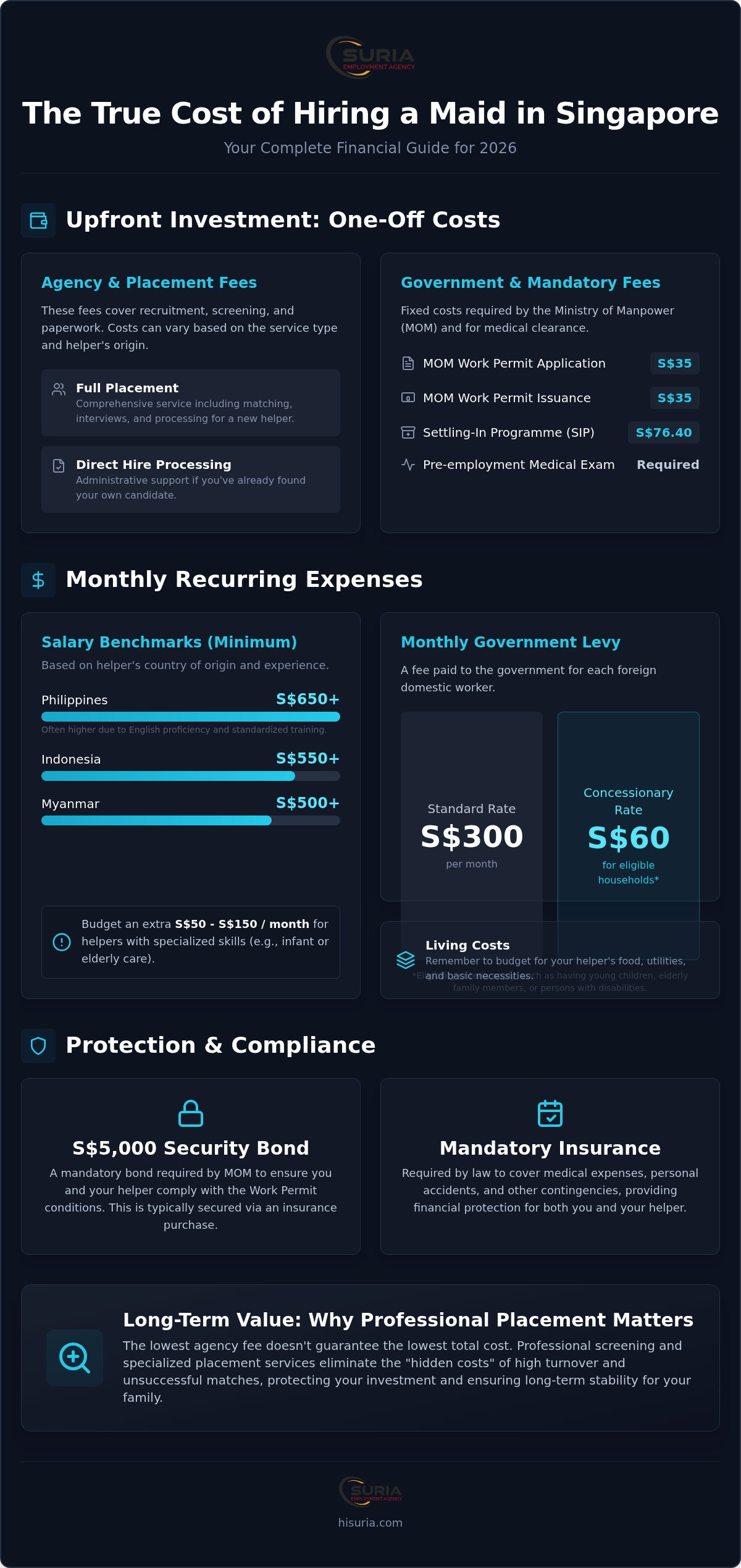
Beyond agency service charges, several mandatory fees are paid directly to the government or service providers. The Ministry of Manpower (MOM) requires an application fee of S$35 to process the work permit. Once approved, an additional S$35 is required for the issuance of the permit itself. These charges are fixed and apply to every employer regardless of the hiring route chosen.
First-time helpers must also attend the Settling-In Programme (SIP). This mandatory course costs S$76.40 and educates the helper on safety and local norms. The regulatory framework for Foreign Domestic Workers in Singapore ensures that both the employer and the employee understand their rights and responsibilities from day one. This structured approach helps the helper adjust to their new environment quickly and safely.
Employers must also factor in the pre-employment medical examination (6ME). This check ensures the helper is physically fit to perform household duties. While costs vary by clinic, budgeting for this ensures there are no surprises during the medical clearance phase. Before finalizing your budget, it’s worth reviewing how the maid placement fee Singapore regulations govern salary deduction timelines and MOM-mandated caps, so every dollar you spend remains legally sound. By handling these details with precision, you ensure a smooth start to your helper’s tenure and maintain full compliance with Singapore’s employment laws.
Monthly Recurring Expenses: Salary, Levy, and Living Costs
Once the initial paperwork is settled, your focus shifts to the sustainable monthly cost of hiring a maid in singapore. This recurring budget consists of three primary pillars: the helper’s salary, the government levy, and household maintenance costs. Balancing these figures requires an understanding of current market benchmarks and the specific needs of your family. It’s about finding a sustainable middle ground where the helper is fairly compensated and your household budget remains stable.
Minimum Salary Benchmarks by Country
The base salary for a domestic helper is largely influenced by her country of origin and prior experience. As of August 2026, Myanmar helpers typically start at S$500, while Indonesian helpers average S$550. Filipino helpers often command a higher base of S$650 due to their high proficiency in English and standardized training requirements. Transfer maids, who are already residing in Singapore, often negotiate higher wages than new hires because they’ve already adapted to the local environment. If you need specialized care for infants or the elderly, budgeting an additional S$50 to S$150 monthly helps attract candidates with the necessary skills and certifications. For families seeking a global standard of specialized educational support for their children, Royal Family Concierge provides high-end family consultancy that pairs well with professional domestic staffing.
The Migrant Domestic Worker (MDW) levy is a mandatory monthly tax paid to the Ministry of Manpower. The standard rate is S$300 for your first helper. If your household requires a second domestic worker without qualifying for concessions, this rate increases to S$450. Timely payment is vital. Late fees start at 2% or S$20 per month, and persistent arrears can lead to the revocation of the work permit. Staying organized with these payments ensures your helper’s legal status remains secure.
Beyond the salary and levy, you should budget S$200 to S$300 for food, utilities, and personal hygiene items. Adding a new member to the home naturally increases grocery bills and electricity usage. For a more detailed breakdown of hiring costs, it’s helpful to view these as investments in your family’s daily peace of mind. Providing a comfortable living environment isn’t just a legal requirement; it’s the foundation of a long term, successful placement.
Managing these monthly variables becomes much simpler with a partner who understands the nuances of the local market. You can explore our transfer maid placement services to find experienced helpers who are already adjusted to the Singaporean lifestyle, often making the transition smoother for everyone involved.
Protection and Compliance: Insurance, Security Bonds, and Medical Exams
Maintaining compliance isn’t just about following rules; it’s about protecting your household from unforeseen financial shocks. While salary and levies are predictable, the long term cost of hiring a maid in singapore is often determined by how well you manage insurance and regulatory requirements. Professional oversight ensures these administrative layers don’t become a source of stress or unexpected debt. We prioritize these details so you can focus on your family’s well being.
Understanding the Security Bond and Insurance Tiers
Every employer must furnish a S$5,000 security bond to the Ministry of Manpower. This bond serves as a guarantee that you’ll comply with the work permit conditions. Most families choose to pay a small premium for an insurance policy that covers this bond, rather than depositing the full S$5,000 in cash. By 2026, mandatory insurance requirements have reached specific benchmarks to provide better protection. You’re required to have at least S$60,000 in annual coverage for inpatient care and another S$60,000 for personal accident insurance.
Choosing a higher insurance tier often proves more cost effective than the basic minimum. A medical emergency can easily exceed standard coverage, leaving you to pay the balance out of pocket. At Suria Employment Agency, we facilitate these applications as part of our full service handling. We help you select tiers that offer the best balance of premium costs and actual protection, ensuring you aren’t left vulnerable to high medical bills.
Ongoing Medical and Regulatory Compliance
Compliance continues throughout the helper’s tenure with the mandatory Six-Monthly Medical Examination (6ME). These check ups screen for pregnancy and various health markers, ensuring the safety of everyone in your home. Missing a 6ME deadline can lead to the immediate revocation of the work permit, which might trigger the forfeiture of your security bond. We help our clients stay ahead of these dates by coordinating the necessary appointments and tracking the schedule for you.
When it’s time for a Work Permit Application and Renewal, the administrative burden increases. Passport renewals and endorsements require careful coordination with various embassies. Proper budgeting should also include the eventual Repatriation Service. The employer is responsible for the cost of the flight home and any related travel documentation at the end of the contract. Our 20 years of experience ensures these transitions are handled with dignity and precision, protecting your reputation as an employer while keeping your total expenses transparent and controlled.
Government Subsidies and Cost-Saving Opportunities in 2026
Lowering the cost of hiring a maid in singapore is entirely achievable when you understand how to navigate government support systems. Singapore’s policy landscape is designed to assist caregiving households, providing substantial relief for families with specific needs. By identifying which subsidies you qualify for and selecting a strategic hiring route, you can manage your household budget with greater precision and peace of mind.
The MDW Levy Concession Scheme
The most impactful saving for most families is the Migrant Domestic Worker (MDW) Levy Concession. Households with a Singaporean child under 16, an elderly person aged 67 or above, or a person with disabilities are eligible for a reduced rate. Instead of the standard S$300 monthly levy, you’ll pay just S$60. This results in a monthly saving of S$240, which adds up to S$2,880 per year. Most age-based concessions are applied automatically by the Ministry of Manpower (MOM) during the work permit application. For disability-related cases, you must register through the Agency for Integrated Care (AIC) to confirm your eligibility before the subsidy is granted.
Transfer Maids: Lower Upfront Costs?
Strategic hiring choices further enhance these savings. A transfer maid often involves lower upfront agency fees because the helper is already in the country. You won’t need to pay for international airfare or the S$76.40 Settling-In Programme (SIP) fee. While these helpers may request higher monthly wages based on their experience, the lack of heavy initial placement costs often makes them more affordable in the first year. We provide expert Transfer Maid Placement services to ensure these transitions are seamless and legally compliant.
Direct Hire services represent another cost-effective path for employers who’ve already identified a candidate through their own networks. By utilizing our administrative support for a direct hire, you avoid traditional recruitment fees while ensuring all MOM regulations are met. Our role is to act as your protective mentor, guiding you through the documentation to secure every possible subsidy. This proactive approach ensures you maximize your savings while building a stable, long-term caregiving solution for your home. Taking the time to understand these concessions transforms a complex financial decision into a manageable household investment.
Long-Term Value: Why Professional Placement Reduces Financial Risk
The true cost of hiring a maid in singapore isn’t just the sum of the receipts you pay in the first month; it’s the value of a successful, long-term match. Many employers focus solely on the initial price tag, overlooking the “Hidden Cost of Failure.” If a helper is a poor fit and leaves within the first few months, you lose your administrative fees, airfare investments, and the time spent on training. Professional screening acts as a stabilizing force, protecting your household from the financial and emotional exhaustion of high turnover.
Mitigating the Risk of Early Termination
Starting with a “cheap” agency often leads to higher expenses in the long run. These providers may skip the rigorous background checks and personality matching required for a stable home environment. When a placement fails early, you’re often left with unearned placement fee credits that are difficult to utilize, forcing you to start the expensive recruitment process from scratch. Understanding how the maid placement fee in Singapore is structured — including the two-month salary deduction cap and MOM-regulated timelines — helps you evaluate agency terms with greater confidence and avoid agreements that leave you financially exposed. Our 20 years of experience allows us to identify potential mismatches before they reach your doorstep. We prioritize post-placement support and mediation to resolve minor friction points, ensuring your investment remains secure and your helper stays motivated. A structured maid interview in Singapore is one of the most effective tools for identifying the right candidate before any fees are committed, and our 2026 employer’s guide walks you through every question and compliance requirement you need.
Suria Employment Agency: Your Partner in Compliance
Choosing a licensed, experienced partner means you don’t have to navigate the complex administrative lifecycle alone. We manage everything from the initial New Maid Placement to the eventual Repatriation Service. Our team handles the technical details of Renewal & Endorsement of Passports and Home Leave Processing, so your household routines remain uninterrupted. This comprehensive oversight ensures you never face penalties for missed deadlines or expired documentation.
To help you maintain a clear financial perspective, use this final checklist for budgeting your first year of domestic help:
- Upfront Administrative Costs: Budget for agency fees, MOM application charges, and the Settling-In Programme.
- Monthly Salary and Levy: Account for the helper’s base wage and the S$300 standard levy (or S$60 concessionary rate).
- Insurance and Security Bond: Secure mandatory medical and personal accident coverage with appropriate tiers.
- Medical Compliance: Factor in the recurring costs of the mandatory 6-month medical examinations.
- Variable Living Expenses: Allocate S$200 to S$300 monthly for food, utilities, and personal necessities.
By viewing these figures as a strategic household investment rather than a simple expense, you build a foundation of trust and stability. We’re here to act as your protective mentor, ensuring that the cost of hiring a maid in singapore translates into genuine peace of mind for your family.
Securing Your Family’s Peace of Mind
Managing your household budget effectively requires looking beyond the immediate price tag. By utilizing government levy concessions and prioritizing professional screening, you can significantly lower the long term cost of hiring a maid in singapore. We’ve explored how upfront administrative fees and mandatory insurance protect your family from financial risk. Selecting the right hiring route, whether through a transfer placement or direct hire processing, ensures that your investment provides lasting stability rather than recurring turnover costs.
At Suria Employment Agency, we’ve spent over 20 years building trust with Singaporean families as MOM licensed experts. Our comprehensive services take the administrative burden off your shoulders, allowing you to focus on your family’s well being. We’re ready to guide you through every regulation and documentation requirement with the care and precision your home deserves. Our expertise in both transfer and direct hire services ensures your specific needs are always met with professional integrity.
Get a transparent quote for your helper placement today and take the first step toward a worry free household. You don’t have to navigate these complexities alone; we’re here to ensure your journey is smooth, compliant, and cost effective. Let us help you build a stable foundation for your home today.
Frequently Asked Questions
How much is the maid levy in Singapore for 2026?
The standard monthly levy for your first domestic helper is S$300. However, many households qualify for a concessionary rate of S$60 if they have a child under 16, a senior aged 67 or above, or a person with disabilities. If you hire a second helper without qualifying for a concession, the rate increases to S$450. Timely payment is essential to avoid a 2% monthly penalty and potential work permit revocation.
Is it cheaper to direct hire a maid or go through an agency?
Direct hiring can lower the initial cost of hiring a maid in singapore by bypassing traditional recruitment fees. While you save on agency service charges, you become responsible for all MOM documentation, medical screenings, and insurance arrangements. Our Direct Hire service offers a cost-effective middle ground. We manage the complex paperwork and regulatory compliance for a transparent fee, ensuring you avoid expensive administrative errors while keeping your upfront investment manageable.
What is the minimum salary for a domestic helper in Singapore?
Minimum salaries are generally determined by the helper’s country of origin and current market benchmarks. As of 2026, the guideline for Myanmar helpers starts at S$500, while Indonesian helpers typically receive S$550. Filipino helpers usually command a minimum of S$650 due to standardized training and language proficiency. Experienced transfer maids or those with specialized caregiving skills often negotiate higher wages, reflecting their immediate value to your household’s unique needs.
Are there any hidden costs when hiring a transfer maid?
Transfer maids often involve lower upfront costs because they’re already in Singapore, eliminating international airfare and the S$76.40 Settling-In Programme fee. However, hidden costs can arise from higher salary expectations due to their local experience. You should also budget for work permit renewal fees and updated insurance premiums. Professional screening remains vital here. A mismatched transfer can lead to early termination costs that outweigh any initial savings you gained.
Do I need to pay for my maid’s medical insurance?
Yes, providing medical insurance is a mandatory legal requirement for all employers. For 2026, you must secure a policy with at least S$60,000 in annual coverage for inpatient care and day surgery. You’re also required to provide personal accident insurance with a minimum sum assured of S$60,000. Choosing a higher tier of coverage is often a wise investment, as it protects your household from high out of pocket medical expenses.
What happens to the $5,000 security bond if the maid runs away?
The S$5,000 security bond is a guarantee to the government that you’ll follow work permit conditions. If a helper goes missing, you must report it to the police and MOM immediately to protect your bond. You may forfeit half of the bond (S$2,500) if you’ve made reasonable efforts to find her. Most employers purchase insurance riders that cover the bond’s forfeiture, providing peace of mind and financial protection against such rare incidents.
How much should I budget for a maid’s food and living expenses?
You should budget approximately S$200 to S$300 per month for your helper’s food, utilities, and personal hygiene necessities. This amount accounts for the natural increase in your household’s grocery and electricity bills. Providing a comfortable living environment and adequate nutrition is not just a regulatory requirement; it’s essential for maintaining a positive, long term relationship. This investment ensures your helper remains healthy and motivated to care for your family effectively.
Can I get a refund on agency fees if the helper is not a good match?
Most agencies don’t offer cash refunds for service fees, but professional providers like Suria offer replacement credits or mediation services. If a helper isn’t a good fit, we work closely with you to understand the issues and find a more suitable candidate. This protective approach reduces the financial risk of a failed placement. We prioritize long term stability, ensuring that the initial cost of hiring a maid in singapore leads to a successful household match.
Disclaimer
The articles published on this website are provided for general informational purposes only. While we strive to keep the information accurate and up to date, we make no warranties regarding its completeness, reliability, or accuracy. Readers should verify information independently and seek qualified professional advice when appropriate. Any reliance on this content is at the reader's own risk.