
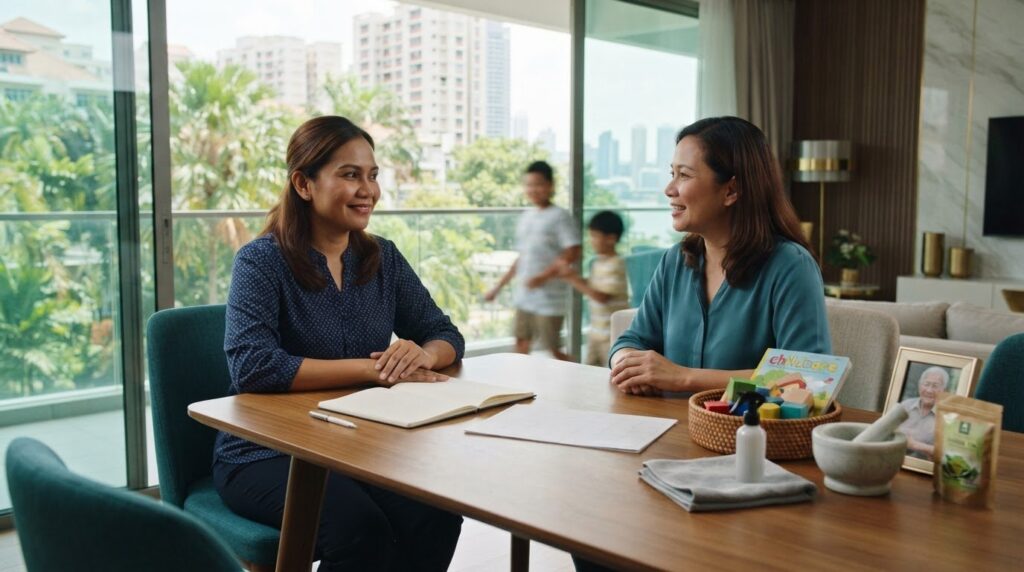
Experience alone doesn’t show whether a helper is right for your household. An Indonesian helper may have worked in different settings or handled particular responsibilities, so Singapore employers considering an experienced maid should focus on the duties she has actually performed. Nationality and years of service don’t, by themselves, establish which skills are relevant to your family.
It’s reasonable to want clear answers before making a choice. This guide explains how to assess a candidate’s previous duties, discuss practical skills and communication needs during an interview, and compare her experience with your household’s priorities. You’ll also learn how to distinguish a new hire with prior experience from a transfer helper already in Singapore. Suria supports Indonesian helper placement through candidate sourcing, interviews and matching, placement paperwork, and Work Permit applications, helping you approach the decision with a clearer picture of the candidate and the process.
Key Takeaways
- Look beyond years of service: identify the helper’s past duties, work setting and specific responsibilities.
- Before choosing an experienced Indonesian maid in Singapore, define your household’s priorities and ask candidates for concrete examples of their work.
- Compare each candidate’s relevant experience with your essential tasks, preferred skills and the areas where you can provide clear instruction.
- Suria supports placement through sourcing, interviews, matching, paperwork and Work Permit applications, drawing on experience since 2002.
What an Experienced Indonesian Maid Can Mean for Your Household
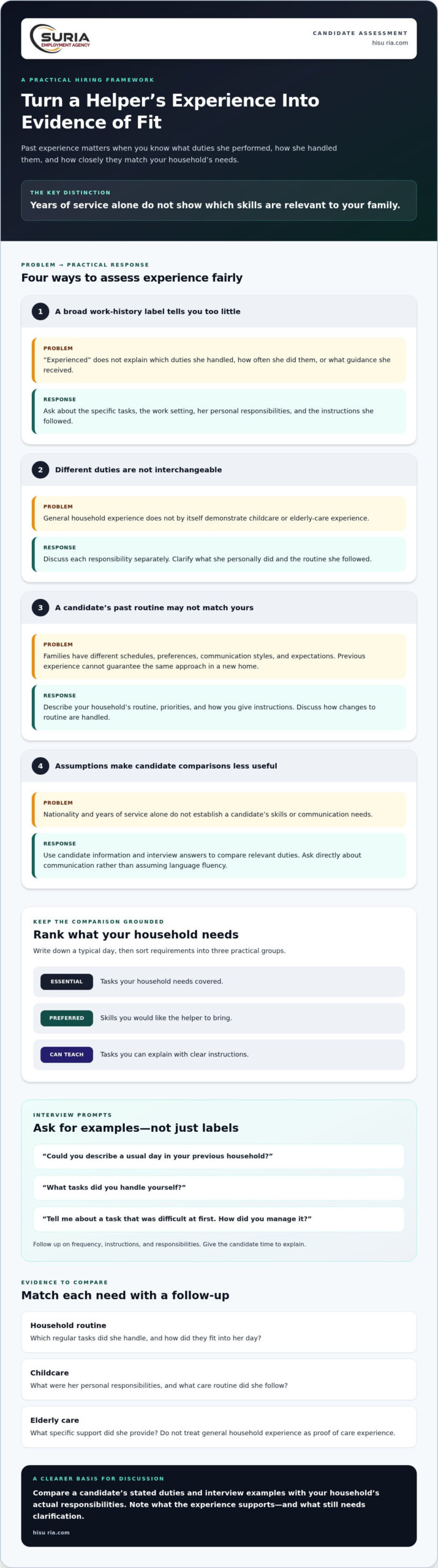
“Experienced” is useful only when you know what the experience involved. A candidate may have worked in a household for several years, but that general employment history doesn’t show which tasks she handled herself, how regularly she performed them, or what guidance she received. Nationality alone also doesn’t establish a person’s skills, communication needs or care experience.
How to interpret an experience claim: Look for specific duties, the setting in which they were performed, and the candidate’s personal responsibilities. Then compare that evidence with your household’s actual routine.
For employers considering an experienced Indonesian maid in Singapore, this distinction helps turn a broad profile description into a practical basis for discussion. Experience with one task is not proof of experience with every related responsibility.
Which experience is relevant to your household?
Separate household duties, childcare and elderly-care responsibilities rather than treating them as interchangeable. For example, general household experience doesn’t by itself demonstrate experience caring for a child or supporting an older family member. Ask which tasks the candidate personally performed, how often, and in what working context. Clarify whether she followed a family’s established routine or had responsibility for organising the task herself.
Experience is not a guarantee of household fit
Families differ in schedules, household preferences, communication styles and expectations. A helper familiar with one family’s approach may need time and clear instructions to understand another’s. Discuss how your household handles priorities, changes to routine and task instructions, and allow space for mutual adjustment.
Prior experience can show exposure to particular duties in a previous setting; it cannot guarantee the same approach, communication or outcome in a new household. The useful question is not simply whether a candidate has done similar work, but how closely that work resembles the responsibilities you need her to take on.
How to Assess an Indonesian Helper’s Experience Before Choosing
Use a consistent process to compare candidates fairly. First, list your household’s priority duties. Next, review each candidate’s information for relevant work history, then ask for specific examples and compare the answers with your needs. This helps you assess an experienced Indonesian maid Singapore households may consider without relying on broad labels or assumptions about nationality.
- Define the duties. Separate essential tasks from skills you’d like the helper to have.
- Review candidate information. Note the stated setting, responsibilities and type of experience.
- Ask for examples. Invite the candidate to describe how she handled relevant tasks.
- Compare fit. Record which needs the experience supports and where instructions may be needed.
Questions that reveal practical experience
Ask clear, respectful, open questions and give the candidate time to explain. For example: “Could you describe a usual day in your previous household?” “What tasks did you handle yourself?” “Tell me about a task that was difficult at first. How did you manage it?” Follow up with specifics about frequency, instructions and responsibilities. Discuss communication directly too: don’t assume language fluency from nationality. Explain how your family gives instructions and ask what helps her understand them clearly.
Compare candidate information carefully
Compare stated duties with your priorities, not nationality labels. Suria’s helper profiles currently require login, so they aren’t publicly viewable. Use the information provided for each candidate alongside interview answers, and note any details that need clarification.
For a simple comparison, match each need with evidence and a follow-up:
- Household routine: Ask which regular tasks she handled and how she organised them.
- Childcare: Clarify her personal responsibilities and the care routine she followed.
- Elderly care: Ask what support she provided, without treating general household experience as proof of care experience.
For employer responsibilities and Work Permit information, refer to the Ministry of Manpower (MOM) guidelines for foreign domestic workers. Suria’s Indonesian helper placement support includes candidate interviews and matching.
Match an Experienced Indonesian Helper to Your Household’s Needs
Start with your household, not a candidate label. Write down a typical day, including which tasks happen regularly, who needs support and when routines are busiest. Then rank each requirement as essential, preferred or something you can teach with clear instructions. This keeps comparisons focused and fair.
Build a realistic household requirements list
Be specific. “Cooking” could mean preparing familiar meals from written instructions, while “help with children” could involve a different set of responsibilities in each family. Describe the actual tasks and schedule, then compare candidates’ stated experience with those needs. For broader hiring steps, consult a new-maid placement guide; paperwork questions belong in an Indonesian helper documentation guide.
Household need: Regular household tasks.
Experience evidence to discuss: Which tasks the candidate personally handled and how they fitted into her day.
Employer expectation: Explain your preferred routine and priorities.
Household need: Childcare or support for an older family member.
Experience evidence to discuss: The specific responsibilities she held, rather than general household work.
Employer expectation: Set out the support your family needs and the boundaries of the role.
Household need: Clear communication about changing priorities.
Experience evidence to discuss: How she received instructions and clarified tasks in a previous setting.
Employer expectation: Agree on a practical way to explain or adjust the daily schedule.
Set expectations for the first weeks
Even an experienced helper needs clear instructions about your home’s routines, task preferences and priorities. Explain what “finished” means for recurring duties, show where household items belong and make time to clarify misunderstandings. Fair expectations support a more respectful working relationship, an approach reflected in the International Labour Organization standards for domestic workers.
Match demonstrated experience to the duties that matter most, then discuss the remaining expectations openly. Explore Suria’s Indonesian helper placement support for help connecting household requirements with candidate experience.
How Suria Supports Indonesian Helper Placement in Singapore
Choosing a candidate is only one part of placement. Employers also need a clear process for connecting household requirements with a helper’s background and managing the related paperwork. Suria Employment Agency has supported Indonesian helper placement since 2002 and holds MOM Employment Agency Licence No. 02C2836.
What placement support covers
Suria’s placement support includes sourcing candidates, conducting interviews and matching candidate experience with the employer’s stated needs. Sharing a concise household brief helps make those discussions more focused. Include the main duties, the family’s daily routine, any specific care responsibilities and the communication approach that works at home. These details help guide the interview and matching process without treating nationality or a broad experience label as proof of a particular skill.
Documentation is also part of placement. Suria supports placement paperwork and Work Permit applications, helping employers understand the administrative steps involved. Work Permit applications remain subject to the relevant requirements and decisions. For current rules and employer responsibilities, consult the Ministry of Manpower’s official information.
A considered next step for employers
Before enquiring, note which duties are essential, which skills are preferred and what instructions a new helper would need to learn your household routine. This gives the placement discussion a practical starting point. Employers seeking an experienced Indonesian maid in Singapore can share these priorities with Suria so candidate discussions are grounded in their household’s actual needs.
If you’ve already identified a candidate and want to understand the alternative route, a direct-hire guide may be more relevant. For employers who would like placement support, Suria welcomes an enquiry about Indonesian helper placement and household requirements. A clear, unhurried discussion can help establish the next steps, from candidate matching through the associated paperwork.
Take the Next Step with a Clear Household Brief
Choosing support for your home is not only about selecting someone with a longer work history. It is also about beginning with a respectful conversation, clear priorities and realistic expectations on both sides. Before moving forward, note the duties that matter most, the routines that are less flexible and the areas where you can provide guidance as a helper settles into your home. This gives you a practical basis for discussing an experienced Indonesian maid in Singapore and keeps the decision centred on your household’s needs.
You don’t need to have every detail resolved before seeking placement support. A clear outline of your household and a few questions about the next steps can make the process easier to approach. Consider how you’ll share instructions, discuss changes to routines and raise questions respectfully after placement. Thoughtful preparation supports a more constructive start for everyone. For expatriates living abroad who are navigating household transitions in a new country, community platforms like sahayy.com can also provide helpful peer advice and shared experiences.
Suria can help you discuss Indonesian helper placement in line with your household requirements. Enquire about Indonesian helper placement with Suria and take a considered next step toward finding a suitable match for your home.
Frequently Asked Questions
Does an experienced Indonesian maid guarantee a good match?
No. Choosing an experienced Indonesian maid in Singapore doesn’t guarantee that her working style will suit your family. Previous experience can help you assess familiarity with certain duties, but households differ in their priorities and routines. Before deciding, discuss how you and the candidate would handle a change in plans, competing tasks or instructions that need clarification. A shared understanding matters alongside relevant experience.
What should I ask an Indonesian helper about her previous experience?
Ask questions that help you understand her role, not just her length of service. You could say, “Which task were you responsible for from start to finish?” or “What would you do if two household tasks needed attention at the same time?” Follow up by asking how she decided what to do first. Keep the conversation respectful and give her time to answer in her own words.
Can an Indonesian helper’s past experience include elderly care or childcare?
Yes, a candidate may have previous childcare or elderly-care responsibilities, but these should be discussed as specific experience rather than assumed from nationality or general household work. Clarify the person’s role: for example, whether she accompanied an older person during daily activities or mainly completed household tasks in the same home. For childcare, ask what responsibilities she personally handled and under whose direction.
Does an experienced helper still need instructions after placement?
Yes. Every household has its own preferences, so explain how you’d like duties handled even if the helper has done similar work before. A short written task list can help with details such as where items belong or which tasks take priority. Check in regularly at the start, invite questions and adjust instructions if something is unclear. This creates a practical way to address small misunderstandings early.
Disclaimer
The articles published on this website are provided for general informational purposes only. While we strive to keep the information accurate and up to date, we make no warranties regarding its completeness, reliability, or accuracy. Readers should verify information independently and seek qualified professional advice when appropriate. Any reliance on this content is at the reader's own risk.