

Imagine finding the perfect new family for your domestic helper, only to realize your 30-day transfer window is closing and your $5,000 security bond remains at risk. It’s a high-stakes moment that often leaves employers feeling overwhelmed by administrative hurdles and the fear of lingering levy payments. You want a clean break and a positive outcome for everyone involved, yet the Ministry of Manpower’s requirements can feel like a complex puzzle.
We understand that managing a domestic worker’s transition is about more than just paperwork; it’s about protecting your household’s interests while ensuring a helper’s welfare. This 2026 guide teaches you exactly how to transfer maid to another employer singapore without the stress of repatriation or financial gaps. You’ll master the complete legal process, from securing the necessary digital consents to ensuring a successful discharge of your security bond. We’ll walk through the current MOM regulations, insurance updates, and the precise steps needed for a seamless handover that keeps your peace of mind intact.
Key Takeaways
- Understand why a transfer is often more efficient and cost-effective than hiring a new helper from overseas.
- Learn the exact steps for how to transfer maid to another employer singapore using the MOM FDW eService to ensure full compliance.
- Discover how to navigate the 30-day validity rule and manage consent requirements to prevent delays or bond forfeiture.
- Master the practical side of the transition, including settling pro-rated salaries and transferring medical histories for a smooth handover.
- See how professional guidance can resolve potential conflicts between employers and eliminate administrative errors in the paperwork.
Understanding the Legal Framework for Transferring Helpers in 2026
A transfer allows a Migrant Domestic Worker (MDW) to switch employers without leaving Singapore. This process is often the most efficient way to secure experienced help. Instead of waiting weeks for a new arrival from overseas, families gain immediate assistance from someone already familiar with local customs and lifestyle. Learning how to transfer maid to another employer singapore is the first step toward a stress-free transition that benefits both your household and the helper.
The 2026 regulatory landscape emphasizes digital precision. The Ministry of Manpower (MOM) has streamlined the process through the FDW eService, making electronic consent the standard. This system ensures that all three pillars of the agreement, the current employer, the new employer, and the helper, are fully aligned before any changes occur. Historically, Foreign Domestic Workers (FDW) in Singapore have played a vital role in supporting local families, and the current legal framework is designed to protect this relationship while maintaining strict compliance.
Transfer vs. Repatriation: Which is Better?
Choosing a transfer over repatriation is a matter of both economics and ethics. Repatriation requires the current employer to bear the full cost of a flight home, which can be expensive depending on the destination. A transfer avoids this cost while supporting the helper’s career continuity. From a financial perspective, a transfer ensures your $5,000 security bond is discharged correctly once the new employer’s bond takes effect. It also prevents any overlap in levy payments. The responsibility shifts precisely when the new Work Permit is issued, keeping your costs predictable and fair.
Eligibility Criteria for All Parties
Compliance starts with meeting specific requirements. The new employer must demonstrate sufficient household income and a genuine need for help, such as having young children or elderly family members. For the helper, her Work Permit must still be valid, and she must have a passport with at least seven months of validity remaining. It’s also vital that her six-monthly medical examination (6ME) is up to date. If you’re looking for a deeper dive into the hiring side, check out The Ultimate Guide to Hiring a Transfer Maid in Singapore (2026) for more details. Ensuring these boxes are checked early prevents the 30-day transfer window from becoming a source of stress. Knowing how to transfer maid to another employer singapore correctly protects your bond and maintains your status as a responsible employer.
Step-by-Step Guide: The Official MOM Transfer Process
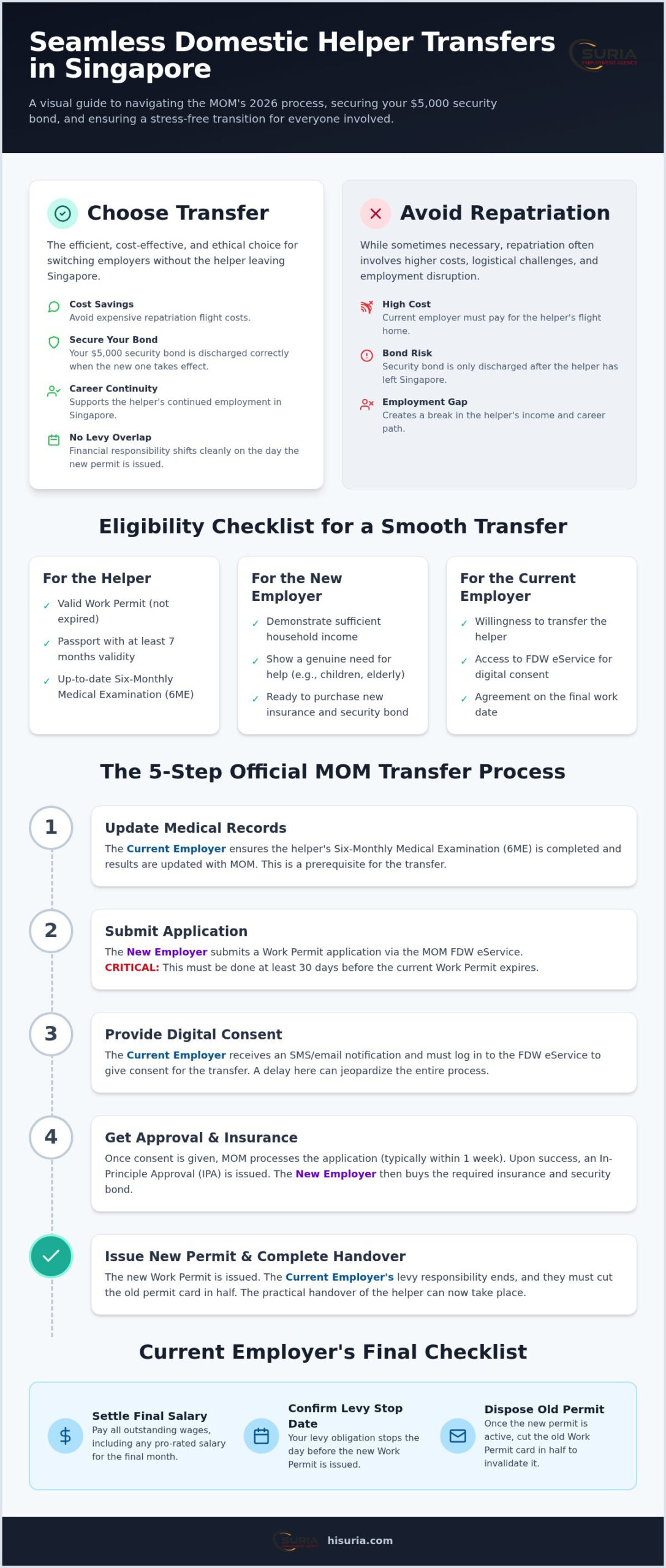
The Ministry of Manpower (MOM) has established a clear, digital-first sequence for domestic worker transitions. While the technicality might seem daunting, following the steps in order ensures you remain compliant with 2026 regulations. A critical part of learning how to transfer maid to another employer singapore involves mastering the 30-day rule. The new employer must initiate the transfer application at least 30 days before the current Work Permit expires. This ensures there’s enough time for processing without risking illegal overstaying or forced repatriation.
The process follows a logical flow that protects all parties. It begins with the current employer ensuring the helper’s six-monthly medical examination (6ME) is fully updated. Without this, the system will block the transfer. Next, the new employer submits the application via the FDW eService. The current employer then receives a notification to log in and provide digital consent. Once this is done, the MOM typically processes the application within one week. Upon success, an In-Principle Approval (IPA) is issued, allowing the new employer to buy the mandatory insurance and security bond before the final permit issuance. For a comprehensive overview of every administrative milestone involved, our complete guide to the transfer maid process in Singapore walks you through each stage in detail.
Responsibilities of the Current Employer
Your role as the current employer remains legally active until the moment the new permit is issued. You’re responsible for the monthly levy, which is currently $300 or a $60 concessionary rate, up until the exact day of the transfer. Timely approval of the transfer request is vital; any delay here can cause the 30-day window to lapse. Once the transfer is complete, you must physically dispose of the old Work Permit card by cutting it in half. This simple act signifies the end of your legal liability and helps ensure your $5,000 security bond is discharged without issues.
Responsibilities of the New Employer
As the incoming employer, you take on the financial and legal guardianship of the helper. You must secure a $5,000 security bond and medical insurance with a minimum coverage of $60,000 for both medical and personal accidents. During the interim period between application and issuance, the helper usually stays with the current employer, though mutual agreements can be made. You’ll also need to download and sign the Declaration Form provided in the IPA. If the paperwork feels like an administrative headache, our team at Suria Employment Agency can handle the entire process to ensure a seamless transition.
Navigating Consent Issues and Transfer Timeline Roadblocks
Consent remains the most significant administrative hurdle in the transfer journey. Because the current employer holds legal responsibility for the helper, their digital approval is mandatory within the MOM’s FDW eService. This requirement exists to ensure a clear handover of liabilities, including the security bond and levy payments. Tension often arises if an employer feels reluctant to release a helper who still has time left on her contract. Mastering how to transfer maid to another employer singapore requires a balance of clear communication and a firm understanding of your legal standing.
Timeline roadblocks are equally challenging. If a helper’s Work Permit is nearing its expiration date, the pressure to complete the transfer intensifies. In cases where the 30-day window is shrinking, employers can apply for a short-term extension of the Work Permit through the MOM portal. This buys valuable time for the new employer to finalize their application and insurance. Proactive management of these dates prevents the helper from falling into an illegal overstay status, which carries heavy penalties for all parties involved.
When Consent is Withheld: MOM Mediation
While the current employer’s consent is generally required, a helper has the right to seek new employment once her contract is completed. If an employer refuses to release a helper at the end of her term without a valid reason, it may be viewed as “holding a helper hostage,” which is ethically and legally problematic. In such disputes, you can engage the Ministry of Manpower for mediation. MOM acts as a neutral third party to resolve conflicts and ensure the helper’s rights are respected. We’ve seen that professional mediation often leads to a signed consent form once both parties understand their obligations and the potential consequences of non-compliance.
The 30-Day Rule Explained
The 30-day rule is a strict requirement designed to prevent last-minute administrative chaos. You must initiate the transfer process at least 30 days before the current Work Permit expires. This period allows for the one-week processing time typical for MOM applications and gives the new employer time to purchase the required $5,000 security bond. If you miss this window, the helper may be required to leave Singapore, and the transfer will be cancelled. To avoid this, many families use a licensed transfer maid agency in Singapore to expedite urgent transfers. An experienced agency can navigate the FDW eService more efficiently, ensuring that every digital signature and document is submitted correctly the first time, saving you from the risk of a failed transfer and the cost of repatriation.
The Practical Handover: Settling Salaries, Medicals, and Belongings
The transition from a digital portal to your doorstep is where the legalities of a transfer meet the reality of household management. Successfully navigating how to transfer maid to another employer singapore requires a structured approach to the human side of the process. A well organized handover ensures that no loose ends remain, protecting your family from future disputes and providing the helper with a clear start in her new environment. This stage is about more than just moving luggage; it is about a professional closure of one chapter and the orderly beginning of another.
Settling the Final Salary and Levy
Financial clarity is the cornerstone of a smooth exit. You must calculate the pro-rated salary up to the exact day the new Work Permit is issued. If your helper has untaken annual leave, you’ll need to decide whether she will use those days before the transfer or if you will pay her in lieu of leave. We recommend using the MOM levy calculator to predict your final bill, as your levy responsibility only shifts when the new permit becomes active. It’s vital to document every final payment, including the return of any savings you may have held for her. A signed receipt for these amounts provides a legal paper trail that confirms all financial obligations were met, preventing misunderstandings later.
The Handover Checklist
A “Clean Break” checklist helps you maintain control over the process. Before the helper departs for her new household, ensure all logistical items are accounted for. This includes the physical return of house keys, access cards, and any employer provided equipment like uniforms or specialized tools. You must also ensure the helper has her passport and all original documents in her possession. To finalize your peace of mind, keep a copy of the security bond discharge notification once it’s processed. This confirms that your S$5,000 bond is no longer at risk. If you find the logistical coordination overwhelming, our team at Suria Employment Agency can act as a neutral third party to facilitate this handover, ensuring every item on your checklist is ticked off professionally.
Logistical coordination also extends to her medical history. While the new employer will conduct their own checks, passing on records of recent vaccinations or known allergies is a helpful gesture that ensures her continued well-being. Coordinating the physical move of her belongings should be done during daylight hours to ensure nothing is left behind; this simple step avoids the need for follow up visits and helps both families maintain their privacy after the transfer is complete.
Why Professional Agency Assistance Ensures a Seamless Transition
Engaging a licensed employment agency transforms a complex administrative task into a guided, worry-free experience. While the digital portals are accessible, the precision required to navigate 2026 labor law updates leaves little room for error. A single data entry mistake in the FDW eService can lead to application rejections or delays that risk the 30-day transfer window. Professional agents act as the steady hand, ensuring that every submission is accurate and compliant with the latest Ministry of Manpower (MOM) standards. This expertise removes the “headache” of paperwork, allowing you to focus on your family’s daily routine while the technical details are managed in the background.
Conflict resolution is another vital benefit of professional support. Transitions can sometimes become emotionally charged, especially when discussing consent or final handover dates. An agency serves as a neutral third party, facilitating clear communication between the current employer, the new employer, and the helper. This mediation ensures that agreements are reached respectfully and legally. Additionally, agencies have established channels for insurance and bond endorsements, which often leads to faster processing times. Mastering how to transfer maid to another employer singapore is far simpler when you have a dedicated transfer maid agency in Singapore to monitor every milestone of the journey.
Suria Employment Agency’s Direct Hire Services
Many families find their own helper through personal recommendations but feel overwhelmed by the subsequent legal requirements. Our Direct Hire Services are specifically designed for these situations. We take over the administrative heavy lifting, managing everything from the initial transfer application to passport renewals and home leave processing. With over 20 years of experience since our founding in 2002, we’ve built a reputation for stability and trust in the Singapore domestic help industry. We treat every case with the care it deserves, ensuring that your unique household needs are prioritized throughout the transition.
Securing Your Security Bond Discharge
The discharge of the S$5,000 security bond is often the biggest concern for outgoing employers. A professional agency provides the oversight needed to ensure this bond is released promptly. We monitor the status of the transfer closely, aiming for the bond to be discharged within one week of the new Work Permit issuance. By proactively tracking the transition, we ensure that your financial liabilities are terminated the moment they should be. You don’t have to spend time refreshing the MOM portal; we provide the updates you need for total peace of mind. Let Suria handle your maid transfer paperwork today and enjoy a transition defined by professional precision and care.
Secure a Seamless Future for Your Household
Transitioning your domestic helper to a new family shouldn’t be a source of stress. By mastering how to transfer maid to another employer singapore, you ensure that legal timelines are met, financial obligations are settled, and your security bond remains protected. Success lies in balancing the digital requirements of the Ministry of Manpower with the practical realities of a household handover. It’s about protecting your financial interests while respecting the helper’s career path and well-being.
Navigating these regulations requires precision and a deep understanding of the latest labor laws. As a licensed MOM agency with over 20 years of Singapore experience, we specialize in expert document processing that takes the administrative burden off your shoulders. We ensure that every consent form and insurance endorsement is handled with professional care. Streamline your helper’s transfer with Suria Employment Agency today to experience a truly seamless transition. You can move forward with confidence, knowing that your household’s stability is in expert hands.
Frequently Asked Questions
Can my maid transfer to another employer without my consent?
No, the Ministry of Manpower requires the current employer’s digital consent via the FDW eService for any transfer to proceed. This ensures a clear handover of legal responsibilities and protects your security bond. However, if the helper has completed her contract, she has the right to seek new employment. In cases of dispute, MOM can provide mediation to resolve consent issues. Understanding how to transfer maid to another employer singapore involves recognizing that mutual agreement is the foundation of the legal process.
How long does the MOM transfer process typically take in 2026?
The Ministry of Manpower typically processes the Work Permit application within one week of submission. Once the In-Principle Approval (IPA) is granted, the new employer must purchase the security bond and insurance. The entire transition usually fits within a 30-day window before the current permit expires. Starting the process early prevents last-minute delays and ensures a smooth administrative handover without the need for short-term pass extensions or unnecessary repatriation costs.
Do I need to pay for my maid’s flight home if she transfers to a new employer?
You don’t have to pay for the flight home if your helper successfully transfers to a new household. The responsibility for repatriation costs shifts to the new employer once they issue the new Work Permit. This is one of the primary financial benefits of a transfer versus ending a contract. It allows you to avoid the cost of an air ticket while supporting the helper’s continued employment in Singapore; it’s a win-win for both families.
What happens to my $5,000 security bond when the transfer is complete?
Your $5,000 security bond is typically discharged within one week after the new employer’s Work Permit is issued. The MOM system automatically triggers the discharge once the helper is no longer under your legal care. You should monitor the FDW eService to confirm the status has been updated. This automatic process ensures that your financial liability ends precisely when the new employer’s responsibility begins, providing you with a clean break and peace of mind.
Can a transfer maid start working for the new family immediately?
The helper cannot start working for the new family until the new Work Permit has been officially issued. Even if the IPA is granted, the current employer remains legally responsible for her until the transfer is finalized. Working before the new permit is active is considered illegal employment. Both parties must wait for the digital confirmation from MOM before the helper physically moves and begins her new duties in the new household.
Is a medical checkup required for a transfer helper?
A transfer helper must have a valid six-monthly medical examination (6ME) record in the MOM system. If her 6ME is due or has expired, the current employer must ensure it’s completed before the transfer can be processed. While a brand-new pre-employment checkup isn’t always mandatory for transfers, the new employer should verify that all health screenings are up to date. This ensures compliance with 2026 regulations and protects the health of the new household.
What are the agency fees for a direct transfer in Singapore?
Agency fees for a direct transfer vary depending on the level of administrative support required. These fees generally cover the Work Permit application, security bond processing, and insurance endorsements. While we don’t provide a fixed industry-wide price, choosing a licensed agency ensures that the paperwork is handled accurately. This investment prevents costly errors and ensures that how to transfer maid to another employer singapore remains a smooth, professional process for everyone involved.
Can I cancel the transfer after the IPA has been issued?
You can cancel the transfer at any point before the new Work Permit is actually issued. If the current employer or the helper changes their mind after the IPA is granted, the application can be withdrawn through the MOM portal. However, once the new permit is active, the transfer is legally complete. It’s best to resolve any doubts during the initial application stage to avoid complications with insurance premiums and bond endorsements that have already been prepared.
Disclaimer
The articles published on this website are provided for general informational purposes only. While we strive to keep the information accurate and up to date, we make no warranties regarding its completeness, reliability, or accuracy. Readers should verify information independently and seek qualified professional advice when appropriate. Any reliance on this content is at the reader's own risk.